

There’s a moment in writer/co-director, Jonathan Brown’s, gritty new play, Knife on the Table, that justifies its run almost on its own. Flint, a decent kid going astray, is "invited" to prove he’s ready for the next step in his drug-dealing career by stabbing Bragg, another "soldier", who has become more trouble than he’s worth.
I immediately thought of The Godfather and the iconic, seductive, even beautiful language in which this rite of passage is labelled "making your bones". So much gangster culture is framed by the script, cinematography and charismatic acting of Francis Ford Coppola’s trilogy, that it’s easy to forget that the demand is always embedded in brutality, in bullying, in barbarism. To witness the cruel manipulation of kids’ vulnerabilities up close and personal, is to take an astringent draft of green tea after Coppola’s sweet, deceitful, marsala wine.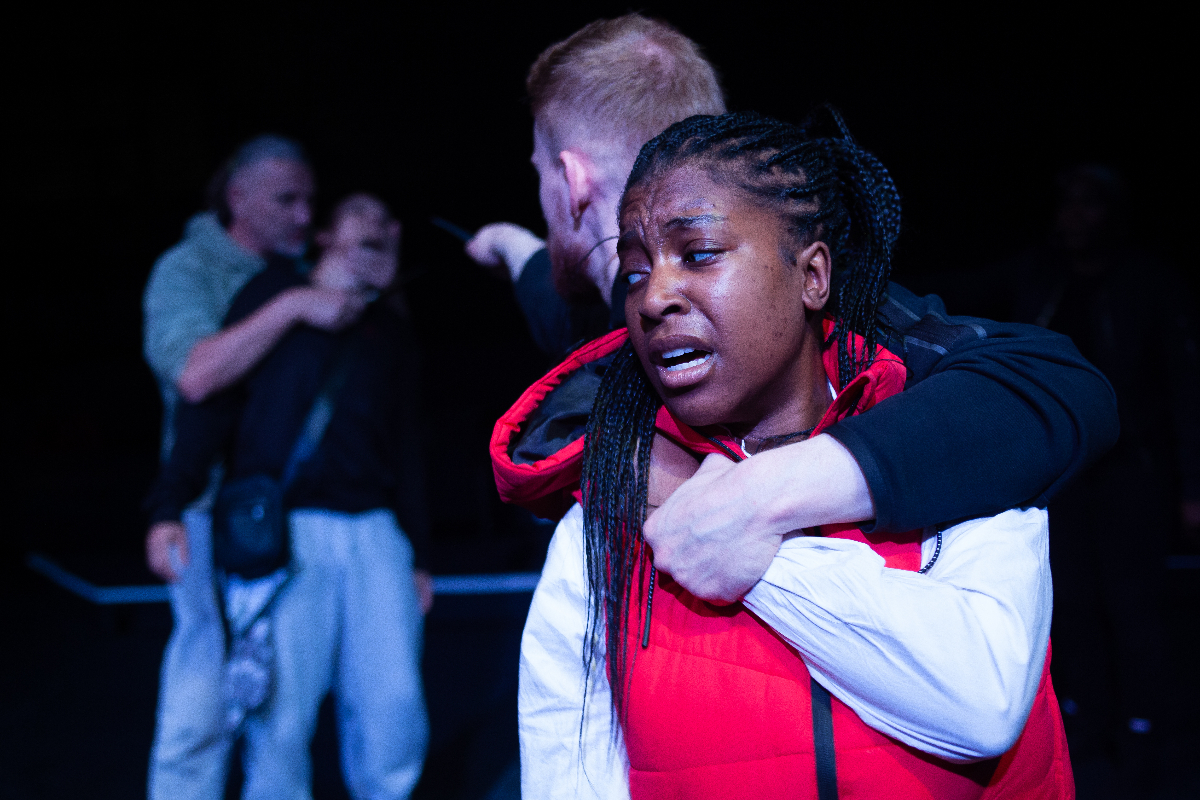 We’re in the estates of West London, Grenfell Tower’s burnt out shell looming above, where Flint is all braggadocio, the kid who has the gear other kids want. He’s on the way to the bling, cribs and cars he desires (at least he thinks so) but he can’t get to his childhood sweetheart, Book, who is fired by the desire to become a surgeon and knows Flint is on a very different path.
He battles with his mother, Chantal, who is estranged from his father, Danny, once a dealer himself, now reformed and with a new girlfriend, Carol. Book’s friend, Shania, is pregnant at 14 with Bragg’s baby, a situation to which he reacts with predictably psychotic violence. Angel, the Don of a network of street dealers, has spotted Bragg’s unreliability and realises Flint is a more promising recruit - once he gets Bragg out of the way. He hands the kid the tool for the job - the chance to make his bones.
The strength of the production (aside from Fred Hill’s menacing drumming, perched above the stage like a malevolent god of thunder) lies in its visceral immediacy. The language is right, the rhythms of speech right and so too the vulnerabilities on which those higher up the food chain prey in order to get their way. Brown has spent time with young people whose lives are spinning out of control, and that underpinning of verisimilitude grounds the drama. It will hit young people in the audience with a searing smack of reality.
It also limits what he can do with his characters who, with one exception, are hemmed in by the types they are required to portray. Moyosola Olashore lends an earnestness to Book - you feel the teenager’s desire to escape and to be loved - but not much more. We clock Rowan Armitt-Brewster’s Bragg (pictured above with Helen Ajayi) as a madman the first time we see him and he never escapes from that straitjacket. Brown himself gives Angel the alpha-male, steady, calm delivery derived from power founded in ruthless routine violence - another type we’ve seen before.
It’s only Jez Davess-Humphrey who has the opportunity to inject nuance into a role, as we witness Flint getting out of his depth, learning how to prey on others, lashing out at ‘women’ as a reaction to his abandonment by his father and, ultimately, becoming overwhelmed by the vortex into which he has been pulled through boredom and misplaced confidence. Davess-Humphrey uses his personal charisma to ensure our emotional response to Flint is always equivocal, a complexity denied to other characters, who are swiftly sorted into goodies and baddies, perpetrators and victims.
The play works best in its middle scenes either side of a cross-talking opening that comes too soon for our ears to have become accustomed to accents and the pace of speaking in a space the hard surfaces of which make acoustics tricky, and a melodramatic ending that stretches credibility. It’s in those quieter moments, in which the power dynamics are explored (at times reminiscent of Julius Caesar) that the play’s morality is grounded.
For all its strengths and weaknesses, theatre in 2024 needs productions like this one from Something Underground, immunised as we are by the news cycle’s relentless reports of knife crime, followed by politicians’ hand-wringing, the tabloids’ moral outrage and, eventually, some posters in bus shelters. It shows that the only way to create knife-free streets is to give hope and meaning to the lives of young people navigating the perilous journey from childhood to adolescence and on into adulthood.
And that’s a job for all of us.











