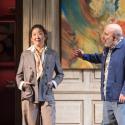
From Monteverdi to Schubert to Bernstein and Lloyd Webber the dramatic song cycle has travelled far and wide over the centuries, though not until Jason Robert Brown’s The Last Five Years in opposite directions. His two-handed tour-de-force – first seen Off Broadway in 2002 – shadows Cathy (Samantha Barks, who was Eponine in the film of Les Mis) and Jamie (Jonathan Bailey) as they find and lose each other at a time when both are seeking recognition in their creative lives.
He is a writer, she an actress; his timeline moves forwards, hers backwards. They meet only once. But as one moves towards the light and the other towards darkness, hope and despair somehow find harmony in disharmony. Songs can do that. And with songs this good, who needs dialogue?
You almost wonder where this show can possibly go when the opening number is so strong, so emotive, so damn heartbreaking. Cathy is “Still Hurting” from the break-up of her relationship with Jamie and Samantha Barks is already singing the crap out of her darkest hour when we’ve barely settled in our seats.
 One of the extraordinary skills that composer Brown (who is also the director of this revival) exercises so tellingly in his score is an innate kinship between numbers – the way that songs share DNA and relate to and impact upon each other. It may only be subliminal for some but these songs are all of a piece, and while Cathy is “Still Hurting” and Jamie “Moving Too Fast” in a blur of euphoric infatuation, a shared phrase of music can mean something entirely different in both contexts.
That second song is a blinder and as Bailey – sensationally good as Jamie – breathlessly loses his reason, you see how the songs in this score need “acting”: how the emotions they express, the joy and/or sadness they convey, have to be felt as well as sung. You might think that is a given but I have seen this piece achieve a fraction of the impact it does here because the narrative detail and the feeling springing from it just wasn’t there.
Sure, the lyric to “Shiksa Goddess” is funny – hysterical even – but it is immeasurably funnier if the insanity of its imagery is despatched, as it is by Bailey, like every single idea is his own and out of his mouth before he can edit it. His comic timing is superb and his physical “tells” make something truly memorable of “The Schmuel Song”, the Christmas Day number that manages to be as funny as it is touching.
Barks, too, rings true and has writ large the frustration of the actor’s lot (“Climbing Uphill”) and through her you feel the warmth of Jamie’s smile in “I’m a Part of That” because Brown has written a refrain so radiant that it almost doesn’t need words to convey the inner glow.
That inner glow also comes from the two cellos at the heart of the composer’s own orchestration, so eloquently led from the piano by musical director Torquil Munro. Two guitars etch their own distinctive colours whilst Martin Lissola’s violin lends a touch of Klezmer here and there. Derek McLane’s design has each player perched on a brickwork backdrop redolent of a New York fire escape. Windows become video screens lending their own suggestive imagery to the narrative.
But the song’s the thing. And as those two final songs – movingly juxtaposed – find harmony in the disharmony of hope and despair we are reminded how easily those two emotional states can co-exist and how delicate a balance it is.