Shakespeare’s Prince Hal may have rejected Sir John Falstaff as a symbol of his misspent youth, but the real-life monarch Queen Elizabeth I couldn’t get enough of him. Accounts vary of who precisely commissioned The Merry Wives of Windsor – or as some might call it, Falstaff III – but a key factor was known to be Elizabeth’s desire to see him in love.
Shakespeare’s response to the commission was as fresh and frothy as a tankard of ale on a summer’s evening, short on soul and heavy on slapstick. Director Sean Holmes – who rousingly kicked off the Globe’s summer season with his Wild West-style Romeo & Juliet – here presents a stylised farce starring Globe regular George Fouracres as the flamboyantly unscrupulous Sir John.
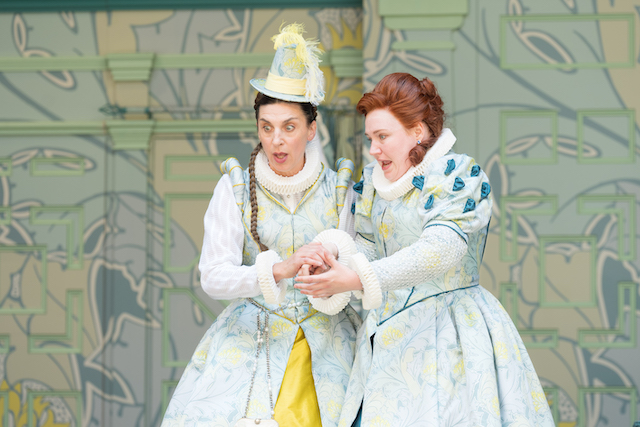
Designer Grace Smart gives the production a William Morris aesthetic – possibly an ironic reference to his celebration of medieval chivalric values – though it also provides an opportunity for a wealth of absurdly elaborate costumes. When the first characters enter, they are prissily clad in ruffs, elegant court shoes, and clothes whose subtle greens match the elegantly floral backdrop. Then Falstaff swaggers in dressed in crimson and fur, and the anarchy begins.
The plot is famously as shallow as a puddle in a heatwave – Falstaff has descended on Windsor, intent on seducing two of its married women, Mistress Ford and Mistress Page. When he sends them identical love letters, he fails to anticipate that they will quite literally compare notes and take revenge on him by devising a series of intricate humiliations.
Emma Pallant as Mistress Page and Katherine Pearce as Mistress Ford both reveal themselves as formidable opponents to Falstaff’s buffoonery. As Pallant reads out Falstaff’s hapless love letter, she spits out the rhymes with as much disdain as if they were fishbones, “Thine own true knight, By day or night, Or any kind of light, With all his might, for thee to fight”. Though the momentum of the evening takes a while to get going, things pick up when two of Mistress Ford’s servants lift the laundry basket where Falstaff is hiding from her husband and start to shake like jelly from the burden. From this moment on the physical comedy matches the verbal comedy and the evening takes off.
 Fouracres nicely captures the mixture of bumptious arrogance and sexual desperation that propels Falstaff through this collapsing card house of seduction disasters. He is considerably aided and abetted by the antics of Jolyon Coy as the explosively jealous Ford, who disguises himself as a man called Brook so he can approach Falstaff and find out what his intentions are with his wife. At first Ford is not in on the joke set up by his wife and Mistress Page – to force their would-be seducer to hide in a laundry basket which is then carried off and emptied into a ditch. When they lure Falstaff into Mistress Ford’s bedroom a second time, and Ford bursts in only to find the laundry basket empty, Coy conveys his desperation by diving in headfirst – an action that on press night caused considerable hilarity.
Much fun is also had with the second plotline, the wooing of the Pages’ daughter Anne (Danielle Phillips) by three suitors. Adam Wadsworth is sublimely comic as two of the suitors; totteringly naïve as Slender, the man who’s too shy even to talk to a woman, and splendidly supercilious as the swashbuckling Frenchman Dr Caius. Marcus Olale is suitably dashing as Fenton, the suitor who eventually wins her heart, and Sophie Russell is a fine and wickedly funny Mistress Quickly, happily overseeing all the mischief making.
In a nice twist, we see how throughout the evening, Pearce’s Mistress Ford becomes steadily more enamoured of Falstaff – and that the chemistry between them far surpasses that between her and her husband. While that doesn’t stop the humiliations, it gives enjoyable pause for thought in this shamelessly silly interpretation that won’t go down as a classic, but still provides more than enough hedonistic fizz for a summer’s evening.