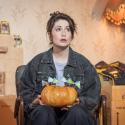
Molly Sweeney has been blind since early childhood. Supported by her understanding father, she has grown into a confident, independent woman. Then her new husband Frank and an ambitious ophthalmologist, Mr Rice, suggest that it might be possible to restore Molly's sight and she undergoes two operations. Partially sighted, she has to learn how to find her way in a mysterious new world where nothing is as she has experienced it. Her sense of herself is undermined, she loses her equilibrium and becomes confused in a mixture of memory and reality, seeing and not seeing.
Brian Friel had already demonstrated his ability to deal acutely with communication - and the lack of it - between people in his masterpiece, Translations, in 1980. Then the premise was the Englishing of Irish place names in and around the fictional Donegal village of Ballybeg. It is a place which recurs in Friel's work, including in Dancing at Lughnasa, perhaps his best known piece. It provides the background, once again, to Molly Sweeney, first produced in 1994, soon after (according to a programme note) the playwright suffered eye pain, anxiety about his sight and two cataract operations.
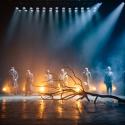
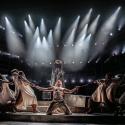
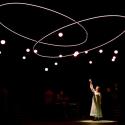
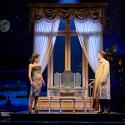
 In construction, Molly Sweeney resembles Faith Healer which also consists of monologues delivered by three characters who interact only in the stories they tell. Molly occupies a tree and a swing in the centre of Signe Beckmann's cool set with its "windows" on to misty Irish landscapes. The swing represents Molly's joyful, childlike emotional control and then the chaos of unpredictability. Frank and Rice remain on either side of Molly except when each lifts her, just once, like a helpless baby.
Citing Oliver Sachs's essay "To See and Not See" among other inspirations, Friel explores Molly's mental state and the effect of the changes in her on Frank and Rice. The latter has his own demons to contend with, a loss of professional respect and the anguish of a failed marriage and separation from his children. Frank, who remains a more or less comic figure, is an autodidact, busily collecting facts on everything from engrams to bees, whales and Iranian goats. After the change in Molly he disappears to Ethiopia and begins to find time for philosophy.
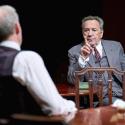
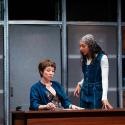
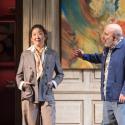
Dorothy Duffy as Molly has a delightful innocence and a shining, open face as she takes the listener into her observations of small town life, love and friendship, mental confusion and isolation. She is ably supported by Stuart Graham as vain, tragic Rice and Ruairi Conaghan as ebullient, know-all Frank (pictured above right). Stuck in their self-obsessed narratives they make it all too clear that seeing is not understanding and talking is not necessarily communication.
This is a brilliant piece of writing, full of humane insights, the busy, gossipy detail of life passing by and gem-clear minor characters - Rice's unfaithful wife and academic rivals, Molly's family, neighbours and workmates and Frank's hare-brained companions. Abigail Graham gives it a respectful, no-fuss treatment, allowing the words speak for themselves.