At the end of The Riots, the Tricycle Theatre’s verbatim response to last year’s upheavals edited by Gillian Slovo and Cressida Brown, a local Muslim whose home was burnt down in Tottenham was asked to give his view on why it had happened. He summed it up with three words: “Just – angry – people.”
Richmond’s excellent Orange Tree has now come up with another, even more urgent analysis adding further flesh to those three words, if little consolation. From their young writers group comes 23-year-old Archie W Maddocks’ Mottled Lines, taken from observation, his own life experiences and, as he revealed in the after-show discussion, a certain amount of additional research. All of which has led him to an impressive if depressingly pessimistic conclusion.
 Mottled Lines is a study in fear and fear’s pernicious repercussions. Gripping all sides of the social divide, with fear, argues Maddocks, comes incomprehension, lack of understanding and ironically, in this most immediately accessible age of digital connection, lack of communication. Maddocks’ major contention is that into that communication gap fear has taken up residence, with devastating results. Fear turns the “other” into a figure of hate – a pattern not unknown to any student of political history. Turn the “other” into an unrecognisable hate figure and, boom, you beget extremism.
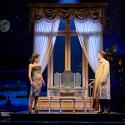
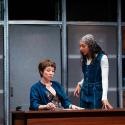
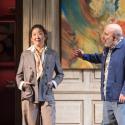
The pattern may be familiar but Maddocks finds a remarkably emotionally mature if occasionally bludgeoning form in which to express his thoughts. In a series of monologues told over 95 minutes, we get accounts from five contrasting characters: Silver Tongue, The Thug, The Sparkle (Akiya Henry, pictured right), The Fight and, perhaps the most beguilingly dangerous, Wolf Behind Kind Eyes. Maddocks gives each their due in Henry Bell’s minimalist white box set which appears to create pedestals on which characters harangue or confront the audience.
The form contains the content which in this case is a double edged sword. At its worst, the lack of inter-personal dialogue becomes a series of rants. But, by the same token, in the Orange Tree’s in-the-round auditorium there is nowhere to hide. We are confronted.
When Charles Mnene’s Thug, face hidden behind his scarf, trousers falling off his bum, returns for a second time and says, “I’m still here”, your heart does sink a little. Thug is frightening and incredibly articulate. He knows the power of language and sees the emptiness behind the words thrown his way by politicians, the police, “authority”. That sense of betrayal and exclusion has made him angry.
 Anger stalks, too, the policeman who in Michael Elkin’s thick-set, shaven-haired portrayal initially carries all the hallmarks of the white racist. But that’s not quite it. Maddocks, keen to overturn stereotypes (not always entirely successfully), gives our policeman justifiable if patronising resentments. At one point, inviting The Thug to take a walk around the stage, he deconstructs his appearance, the codes of belonging, the body language. Fascinatingly, though the analogies and terms of expression are different, policeman and Thug express similar contempt for “those at the top”.
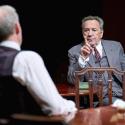
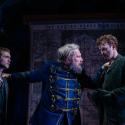
But even here, though Steven Elder’s Silver Tongue (pictured above left) is a dead ringer for the Blair/Cameron school of slippery, public school communicators, Maddocks gives him reasons to be angry. It may not be in quite the same league as our Thug’s social impoverishment but in its sense of angry entitlement it carries its own chill warning. So too does Gabeen Khan’s smooth, highly educated Wolf, beguilingly evoking the quiet consolations of twilight birdsongs only to find a hideous metaphor of social cleansing in the high rhetoric of literature and the purity of a blank white sheet of paper.
Mottled Lines has its flaws, not least in its sense of bleak hopelessness epitomised in Sparkle, of the winding hair and coloured nails and the play’s most vulnerable character, caught between two bullets of fear, pronouncing “death can’t take what’s dead already”. But what a talent is here unlocked. Look out for Archie Maddocks. He has much to tell us.