We open on one of those suburban American families we know so well from Eighties and Nineties sitcoms - they’re not quite Homer, Marge, Bart, Lisa and Maggie, but they’re not far off. As usual, we wonder how Americans have so much space, such big fridges and why they’re always shouting up the stairs.
But this squabbly, stereotypical family is not what it seems. Soon the mother is behaving oddly, there’s a “Here we go again” look in her husband’s eyes and the daughter withdraws, somewhat traumatised. Only the son, who has taken on a Puck-like status as an unreliable observer, appears at ease – we soon find out why.
 Next to Normal comes laden with awards from its 2009 residency on Broadway and from this production’s initial run at the Donmar Warehouse. It’s easy to see how it has garnered such praise, the house captivated by what is now a more familiar, more accepted story than it was 15 years ago. We all know parents like that, teens like that and we’ve all been touched, personally or at close quarters, by the scourge of mental health disorders and their resistance to treatment.
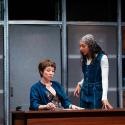
Cassie Levy keeps her Diana real. Her performance as a woman who is intermittently overwhelmed by depression, grief and delusions, is grounded largely in gestures more odd than frightening, histrionics held at bay. It makes it all the more shocking when her suicidal ideation produces blood and leads to the horrors of electroconvulsive therapy. It’s hard not to avert the eyes as she is strapped on to a gurney in an almost mediaeval scene.
Jamie Parker is the everyman husband and dad, loving his wife but perplexed as to how he should express that love when her mind is a roiling ocean of emotions. There’s no sugar-coating here – we see how mental illness can hollow out a relationship, its relentless undermining of the usual norms of reciprocity tilting the scales so far in one direction that the bar eventually snaps – but might be repaired.
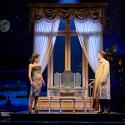
Eleanor Worthington-Cox (Natalie) and Jack Ofrecio (Henry) (pictured above) are the geeky teens who fall for each other, she initially prim and proper and he the stoner, but as the pressure builds on Natalie, she starts to self-medicate on a similar cocktail of psychoactive pharmaceuticals as her mother, and their relationship is tested too.
It’s here that I suspect British audiences will struggle to keep up. Trevor Dion Nicholas (excellent as Diana’s two doctors) dispenses drugs which seem as ubiquitous as burgers in the USA but must surely just be names to many in the house – Xanax, Adderall, Prozac, Ritalin. He also gets the surreal number “Who’s Crazy/My Psychopharmacologist and I” which will bring back memories of Dennis Potter’s sublime The Singing Detective for many.
By far the most attractive character is Gabe (Henry, charming and funny as he may be, is just too wet really). Jack Wolfe has one of the best voices in the West End right now, sensational in his standout number, “I’m Alive” He also hits that sweet spot that leavens blunt malevolence with kindness, keeping us guessing as to his intentions and, as the narrative plays out, even his status in the family.
Tom Kitt provides a full-on rock score (one of many elements of the production that reminds one of Dear Evan Hansen) but the singers are miced-up which means that one can hear clearly Diana’s somewhat self-pitying “I Miss The Mountains”. Brian Yorkey’s lyrics are sharp and, if there isn’t quite a song as strong as Hansen’s “Waving Through A Window” it’s still a more than serviceable score that’ll have fans replaying back their favourites online.
The fault lies in Yorkey’s book, or perhaps more accurately, in its reception by your reviewer. Mental illness is something like Antarctica to me – I know it’s vast and dangerous, requiring all the right equipment to navigate safely, but it’s also featureless and unknowable. The second half especially had me tuning out as Diana’s problems worsened and I could relate only to the shadows they cast on her family. That puts a distance between me and the subject matter that proved (as it so often has in the past) insurmountable.
That said, I was fortunate to speak to friends much more familiar with the impact of mental illness on family life and they confirmed that the show was very much aligned with their experiences and what I had experienced as repetition was, in fact, a subtle delayering of that particular onion.
The musical, bold in conception, skilled in execution and acclaimed with modern theatre’s greatest accolade, a tearful standing ovation, has delivered. Just not for me.