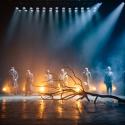
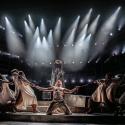
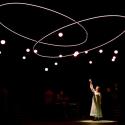
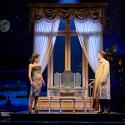
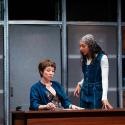
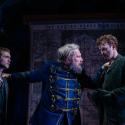
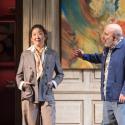
The UK premiere of Dmitry Krymov’s Opus No.7 begins at 5pm. When it finishes two and half hours later, a sun-dappled evening is bustling with the opening weekend of the Brighton Festival. At a nearby pub friends ask, “What was it like? What was it about?” For once I am lost for words. Describing Opus No.7 is akin to conveying an emotionally moving dream which, laid out prosaically, becomes gibberish. The production is as much performance art happening as theatre, zapping the brain with a concatenation of imagery, like a Quay Brothers animation brought to life.
Krymov is the toast of Moscow’s theatrical avant-garde because he’s not only completely out there, he’s also popular. His uniquely mischievous, surrealist approach to Chekhov and Shakespeare, among much else, has seen his reputation bloom both at home and abroad. Opus No.7 is really two pieces, each around an hour long. The first, Genealogy, is themed, broadly speaking, around the tragedy of the European Jewry in the first half of the 20th century. Krymov approaches the subject as a set designer and an artist (he once left theatre for a decade to become a successful exhibiting painter). The audience arrives to take tiered seats in a long row, facing a wall of white boards. A young, heavily pregnant woman in a giant greatcoat is buffing and polishing everything, including the shoes of audience members. She turns out to be Maria Smolnikova, Opus No.7’s lead actress and a ringer for the young Juliette Binoche.
 When the production begins her buffer handle becomes a radio aerial and the business end is hauled off to become her dress. She is joined by fellow actors, the men in shabby evening wear and the women in loose Greco-Roman dresses, but the white wall of boards is, perhaps, the true star. Through it arms and legs cut their way, actresses appear and a notable explosive highlight of Genealogy comes when the actors, in a line, throw tubs of black paint at it, then craft the splatter-patterns into silhouettes of Hassidic Jews. These later explode, cannoning thousands of ticker-tape newspaper squares out over the audience. This shower, it becomes clear, represents the masses lost in the Holocaust. The actors perform routines among them, reading out enigmatic phrases and Jewish names, their words translated via two screens of surtitles. The imagery of the Holocaust is never far – the wall spews out a mass of children’s shoes at one point, at another glasses pop through it, both recalling the contents of the warehouses at Auschwitz. Projected film is also used, an SS officer sinisterly passing along the wall, mutating into a Soviet commissar, hinting at Stalin’s anti-semitic hysteria of the early 1950s.
If Genealogy is a mind-boggling art event, full of surprises that make the viewer rethink how theatrical points can be made while treating its subject with dignity, the second half, Shostakovich, tethers its visual extravagance more firmly to a specific tale, that of the composer of the title, a man whose life and art were inextricably linked to the ideas and oppressions of the Soviet era. The performance starts with actor-stagehands sanding and jigsawing a rickety wooden frame that looks to be the bare skeleton of a grand piano. Played by the petite Smolnikova, wearing his iconic Harry Potter-ish glasses and a suit, Shostakovich is chased about and nurtured by a superb 15-foot puppet matron - Mother Russia - with blinking eyes and gigantic boobs, a routine that’s both funny and touching. Following an acrobatic routine she/he becomes one with – even trapped by - the piano, a scene of machine workshop theatre that recalls the performances of industrialist band Einstürzende Neubauten. Mother Russia eventually changes into Stalin with a smaller puppet Politburo and, accompanied by surtitled chunks of Shostakovich talking his way round his own oppression and swelling chapters from his Leningrad Symphony, as well the gloomier Second Piano Trio, the performance, which includes further extensive surreal acrobatics, seems to represent the composer being hemmed in by the state, climaxing in a fantastic extravaganza best described as a multiple metal piano bumper car rally, a vision as loud and magnificent as it is eye-boggling.
Krymov’s Opus No.7 does something so visual with theatre that, even when the brain doesn’t entirely understand the wider conceptual implications, the event itself fascinates. Despite the dark themes, everything is lathered in unlikely humour. Opus No.7 rarely lets its extreme artistic nature drift into self-indulgence and thus keeps doubters onside, a circus of ideas that leaves the viewer reeling.
Overleaf: watch a minute of clips from Opus No.7