The Menier Chocolate Factory has made something of a habit of late out of trawling unexpected corners of the contemporary American repertoire. A happy result of that last May was the local premiere of the Off Broadway show Marjorie Prime, and now the same director, Dominic Dromgoole, is at the helm of a comparably interval-free play that has yet to reach New York: Paul Grellong's meaty, if sometimes murky, Power of Sail.
As with AI in the earlier play, the issues here are certainly timely: freedom of speech and the depredations of cancel culture in modern-day academe, with Julian Ovenden cast as a Harvard professor, Charles Nichols, who has invited an (unseen) white nationalist to have his say on campus.
 Good luck with that. Before you can say "trigger warning", the groves of Cambridge, Mass are grumbling with the very shock and outrage Nichols has come to deplore. "More speech" rather than less is "the disinfectant" he feels is needed to cleanse an overly cossetted society, though as is the way of these things, few escape the gathering thorniness unscarred.
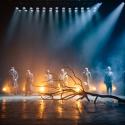
The structure of the play teases the audience, as do its ideas. Arrayed across six scenes, the narrative progresses chronologically for the first four only to double back on itself for the final two. (Only two of the scenes, it's worth noting, occupy the same place.) Ovenden presumably is a past master at such storytelling swerves, having first come to attention in the Donmar premiere of Stephen Sondheim's reverse-chronology musical Merrily We Roll Along, nearly a quarter-century ago.
Grellong doesn't have Sondheim's wit - who does? - and there are multiple instances where one is aware of watching a staged thesis intended to score points rather than a play powered from within. On the other hand, there's a whiff of Ibsen to this writer's interest in peeling back the motivations, not to mention the variable moralities, of his characters, so that virtually no one by play's end emerges as they seemed at first.
Unusually, Power of Sail was first seen in Greenville, South Carolina, of all places in 2019, only to re-emerge post-pandemic in LA with Bryan Cranston at the helm. This fresh iteration finds a bearded Ovenden very much resembling the Georges Seurat he has played (in keeping with the Sondheim motif) in Sunday in the Park with George, and it's always good to be reminded of the versatility of those musical theatre performers equally at home in straight plays.
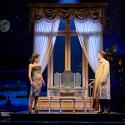
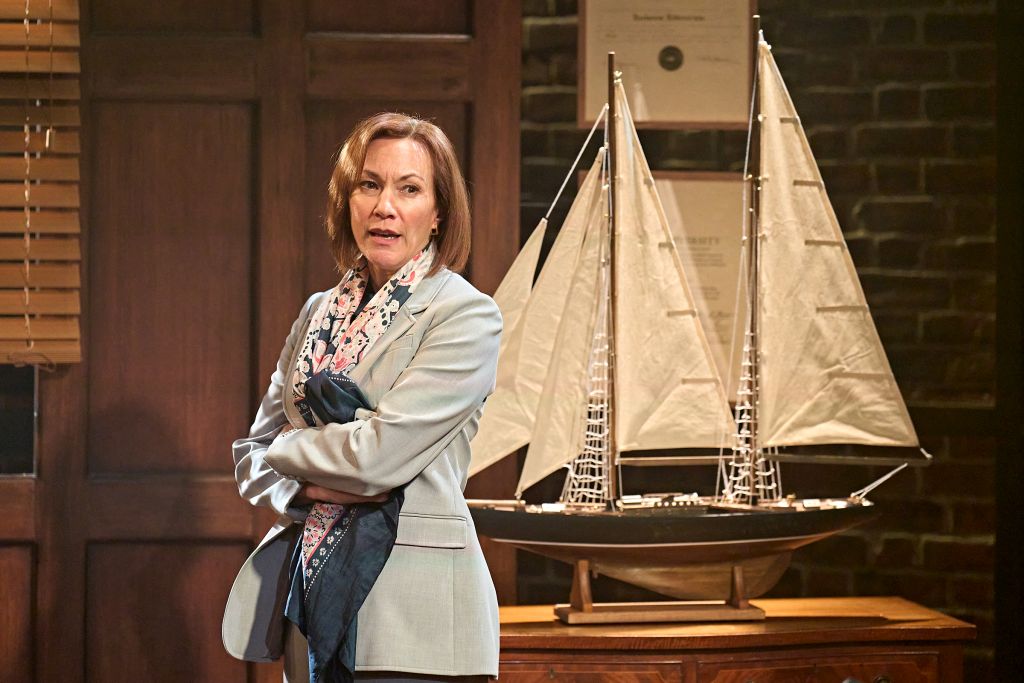
Others in Nichols's midst include Katie Bernstein and Michael Benz as rivals from a younger generation with their eye on the tenured prize. Benz in particular makes something memorable out of a sycophantic sneak whose affability runs skin-deep, whilst Bernstein's feisty Maggie finds an older complement in Nichols's colleague and Dean, Amy Katz (Tanya Franks, pictured above) - she and Maggie both Jews amid a landscape where anti-Semitism is just one of the shrouds hovering over a troubled society.
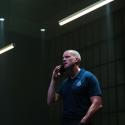
 Some of the smaller roles are ludicrously pro forma, including a resident inquisitor (Georgia Landers) - all such plays have one - who announces portentously, "if there's something else to know, we will come to know it." A game Paul Rider pops up in the final scene as a bartender on hand to make not particularly comic hay, even as Paul Farnsworth's wood-paneled set repositions itself anew. The play's title, by the way, is a Speed-the-Plow-style headscratcher that does in fact make sense, referring to regulations at sea whereby one sort of ship must give way to another. Jostling for position is just the way it is.
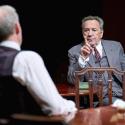
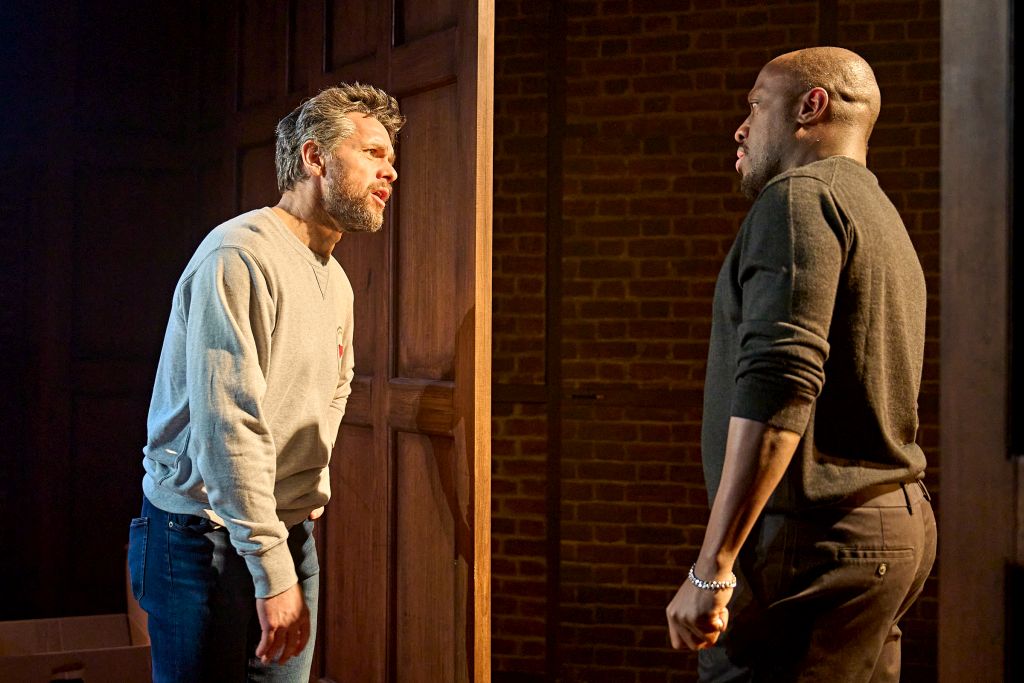
Faring best among the company is the busy Giles Terera (an Olivier nominee this season for Clyde's, and pictured right with Ovenden) who rivets attention with his every appearance as a onetime student of Nichols turned local TV star: his final appearance brings proceedings to a proper emotional boil. Yes, this character, too, gets his share of thesismongering. Twitter, we're told, "is not the real world", but Terera leads from the front with conviction throughout even when the play risks turning into a staged position paper.