

This new play, In The Print – by Robert Khan and Tom Salinsky – gives a pacy account of the seminal moment when Rupert Murdoch moved News International to Wapping. Over the last decade and a half the playwriting duo have rolled up their sleeves to tackle political subjects including Brexit and the fight to succeed Labour PM Harold Wilson – and here they put the lens on the moment that changed the newspaper industry for ever.
It's a spiky depiction of the struggle between trade union leader Brenda Dean and Murdoch that doesn’t sugar coat events, but nor does it resort to demonisation. Instead it asks pointed questions about the media industry and calculations needed to keep up with the pace of change which feel all the more pertinent now that the internet and AI are threatening to leave paper, ink, and indeed human agency languishing in the dust.
Devotees of Succession will appreciate that it was something of a casting coup to get Brian Cox’s son, Alan Cox, to play Murdoch. He delivers a steely, magnetic performance, but it feels a shame that the script doesn’t delve a bit more deeply into his character. In the exchanges between Dean and Murdoch, the latter declares that he is the “true revolutionary” in their situation. It’s an eyebrow raising statement that deserves proper exploration. Certainly it made this critic keep thinking about a story that occurred several decades beforehand.
That story involved a young Australian journalist, Keith Murdoch, who reported on the Gallipoli campaign in World War I. He was outraged by the botched operation – in which he believed that Australian soldiers were essentially being sacrificed by an incompetent British military establishment. Keith’s fury at British upper-class complacency was inherited by his son, Rupert. Though the two didn’t always see eye to eye politically – Keith was not impressed when Rupert put a bust of Lenin on his desk at Oxford University – that ardent belief that the British system needed to be shaken up was a driving force for both.
Possibly that’s a separate play in itself, but since the script ventures down that path it would have been interesting to have more detail, not least when we have insights into how Dean’s relationship with her father shaped her. As this account of Murdoch’s breaking of the unions shows, the Leninist influence didn’t last long. Yet his refusal to kowtow to tradition would be central to his determination to rewrite the future of the British media. No-one could predict all the consequences, not even Murdoch himself. Among other things, his shift from “hot metal” to computer-based printing would directly enable the founding of The Independent.
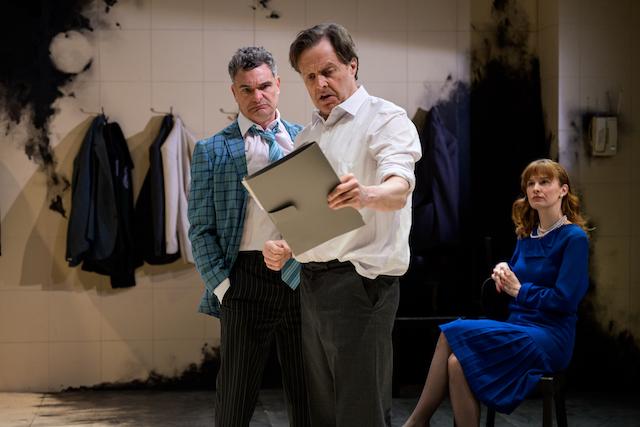
While Dean herself was eventually demoted by her own union members, in Josh Roche’s brisk production Claudia Jolly delivers a performance in which she is shown to be both impressive and empathetic. Dean had been made the General Secretary of SOGAT – the Society of Graphical and Allied Trades – in 1985, becoming the first woman to lead a major industrial union. Her perspective is interestingly complex – she’s more than prepared to challenge the status quo of the printing industry even as she displays a fierce personal integrity. Not least in the scene where she stops The Sun’s editor from calling the National Union Of Miners leader Arthur Scargill “Mine Fuhrer” in a headline, at the same time as persuading the head print worker not to storm off in protest.
The chemistry between her and Cox’s Murdoch is fascinating – both drawn to each other for their straight speaking at the same time as they are repelled by each other’s values. Yet in a time that didn’t lack big journalistic personalities, it seems strange that there are few details about the human cost for those lower down the chain. Still, the versatile cast members gamely juggle the roles of top union and newspaper officials. Russell Bentley (above left) is particularly strong as Kelvin McKenzie, editor of The Sun, and Alasdair Harvey (above centre) does a slick turn as Andrew Neil.
Many of the situations depicted here feel extremely old-fashioned – testimony to the fact that the most ruthless force of all is the exponential acceleration of technology, and that as a media owner you ignore this at your peril. Change might involve huge sacrifice, but so too does the failure to change. There are some longueurs and not all the jokes land – though a quip about Peter Mandelson’s trustworthiness provokes a predictable roar. But this is a robust exploration of a key moment in media history.











