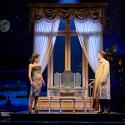
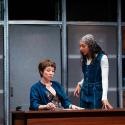
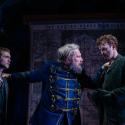
The USA was still months short of Pearl Harbour’s shove into World War II when Bertholt Brecht wrote The Resistible Rise of Arturo Ui. It was many years into a Cold War by the time it was first staged in 1958. It will need a historian of the future to draft the next sentence, the one that heralds its revival at the RSC in 2026. But we were all thinking, and worrying about what exactly it would say – as Brecht intended.
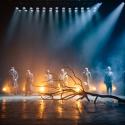
After a prologue and some banners (the more intrusive Brechtian stylings mercifully largely left behind after that) we’re introduced to the fat cats of the Chicago cauliflower racket, riding high on crooked capitalism’s rich pickings. But a shabby thug, running a small time protection racket with a handful of hooligans, senses their complacency and, fired by a messianic will and a crude charisma, we observe his clambering over democracy’s enfeebled checks and balances to seize it all.
Apart from Leni Riefenstahl armed with a GoPro, and with short messages above the stage to tell us who’s who and where we are in the Nazis’ rise to power, the top German goons of the Twenties and Thirties are all there on stage. They go under different names, barely, but it’s hardly a guessing game. It does force us to accept that they are types, men you can find in Munich or Chicago (or Moscow or Washington) in the 2020s as easily as you could in the 1920s.
The considerable task facing director, Seán Linnen, and translator, Stephen Sharkey, is to retain the Expressionist roots of the iconic play, find the black comedy and avoid toppling into pantomimeish caricature, a discourse never too far away from the British theatregoer’s mind. Of course, they’re helped by those of us who once laughed at preposterous men like this a decade or so ago, but who now fear them, half Brecht’s work already done by the daily news cycle.
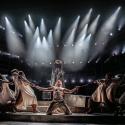
It is Mark Gatiss’s Arturo Ui who must carry this tonal burden primarily and, rather than going for Charles Chaplin’s or John Cleese’s unforgettable comic versions of Der Führer, Gatiss channels Peter Sellers’ oily charm from Dr Strangelove. There’s the hair and the moustache of course, and a thin grin displaying teeth as rotten as his soul, but we see how he gains respect from his entourage, how he intimidates his enemies with his ruthless delight in breaking legal and moral boundaries and his atavistic understanding of how to set one person against another to his own advantage.
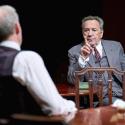
Gatiss tempers the psychosis with humility in a standout scene in which Ui brings in an actor (a superbly hammy Christopher Godwin) to teach him how to speak and walk. Of course, the chosen text is Mark Antony’s funeral oration, the apotheosis of theatre’s rabble-rousing speeches. Ui quickly catches the cadences required to access the power, finds a silly walk and soon retreats to his plotting, another arrow in the quiver. Once again, we’re left wondering if we should be giggling or crying.
Though Gatiss commands the eye whenever he sidles, then strides then struts into view, he gets excellent support from a cast who also suggest their inspirations without ever hitting us over the head with them.
Kadiff Kirwan gives us Ernesto Roma, the big dumb button man, eventually offed, like Ernst Röhm, on The Night of the Long Knives. Mawaan Rizwan and LJ Parkinson (a disabled actor) play the grotesque Giri and Givola (Göring and Goebbels to you and me), the sidekicks riding shotgun on Ui’s rise to power. There’s plenty of cabaret, and Cabaret, in those performances.
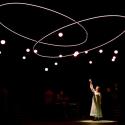
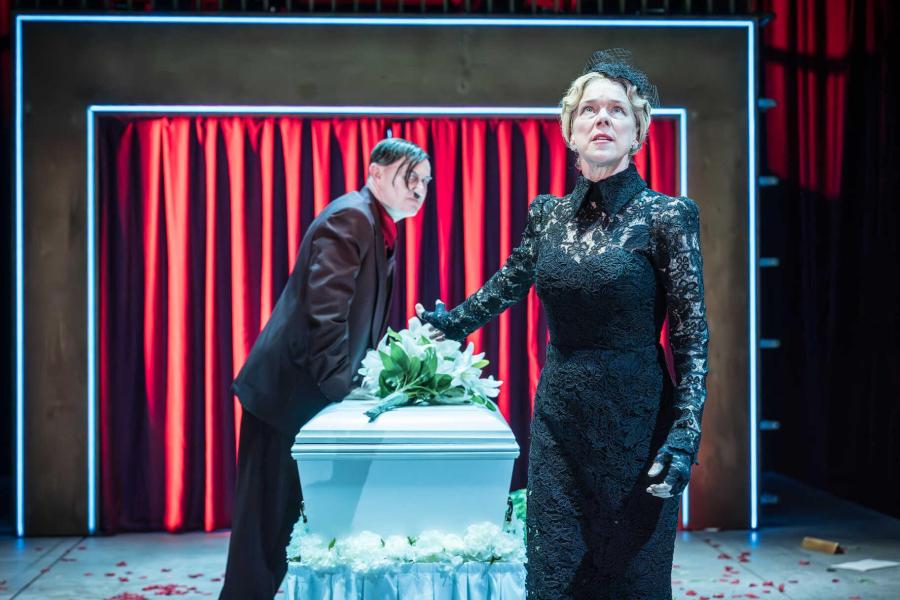
Another terrifying scene is anchored by Joe Alessi as Dullfeet, the mayor of a nearby town Ui sets his eye on, and his wife, Betty, who tries to reason with the tyrant. Her husband will have nothing to do with Ui, but Janie Dee’s (pictured above with Mark Gatiss) elegant woman of the world tries to charm him. Her husband is soon dead and, after a hideous power move by Ui, she’s soon wearing his insignia, silent and scornful, as her town, like Austria, is absorbed into The Reich.
At over two hours playing time, the production is something of a slow burn in the first half, but the urgent music (from Placebo) never lets us forget what’s coming. And the build speeds up to its hammer blow of a conclusion with a manic energy and theatricality which stamps this as a landmark production that will live long in the minds of anyone who witnesses it.
The famous epilogue is delivered by Gatiss without Ui’s sneering strangulated vowels and asks us “What’s next?” And also pokes us in the eye with the question that takes us back 85 years to Brecht himself – “And what are you going to do about it?”