Thought Terence Rattigan was a playwright of the drawing room? Think again. A day after his defining work The Deep Blue Sea opened in an acclaimed revival at the National, Chichester Festival Theatre takes a lavish risk on this epic later work, which swaps dingy post-war London for the beating heat of the Arabian desert, and restrained middle-class passions for bloody revolution.
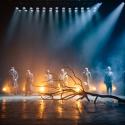
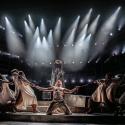
The vast Egyptian columns, scorched-earth stage and whirling Middle Eastern music insist on the "foreignness" of the external scene in Adrian Noble’s production. But internally, it turns out, we’re on familiar Rattigan territory. The hero of Ross, played by Joseph Fiennes, is none other than TE Lawrence. Beneath the billowing white robes, he’s a painfully conflicted English soul of the sort Rattigan so particularly understood.
Ross bites off a vastly complicated chunk of history
“Colourful figures are rare enough in the war,” remarks a newspaper journalist, as he invites the battle-stained Lawrence to his studio tent for a photo session. David Lean’s iconic 1962 film, Lawrence of Arabia, delivered just such a character: Peter O'Toole, six foot two and dashing, striding through the desert with revolution-shouldering charisma. Fiennes is a stockier, stranger, more shifting presence. He is probably far closer to the truth, and certainly doesn’t flatter the dangerous assumption that one Western man could heal the Middle East. As he tells an army commander, this job calls for a Messiah, not a man, and “a European who tries to direct the course of this revolution is apt to find himself rather out of his depth.”
But Fiennes, whose rather wan voice never quite hits the note of commanding nonchalance, sometimes feels out of depth himself in a play that tries to do so much. It begins in an RAF base, where the now world-famous Lawrence has taken “refuge from himself and his reputation” by pretending to be a recruit named Ross. A malaria-induced fever dream returns him to the scene of the 1916-18 Arab Revolt against the Turks, which the British Army unofficially commission him to lead despite his “highly individual” way with a salute.
He is favoured for his knowledge and deep loyalties within the Arab world – Peter Polycarpou's Bedouin sheikh hints at the acceptance Lawrence finds here, with the refrain of "I see no flaw in this man". But he claims to undertake the operation as “a cold-blooded exercise with will power”, and is criticised for his ruthless attitude in the field. This will is broken when he is raped on the orders of a Turkish military governor (played here with a sadistically sensual villainy by Michael Feast), determined to destroy the man behind the enemy mission.
 Ross bites off a vastly complicated chunk of history, seasons it with orientalism, melodrama, British army comedy and some curious experiments with form, and attempts to wash it all down with a complex and ultimately unresolved psychological portrait. Unsurprisingly, it’s hard to swallow. TE Lawrence was many things: scholar, soldier, archaeologist, masochist, latent homosexual, military genius, show-off, recluse, pioneer of glamping… What he isn’t, by anyone’s argument, is an especially clarifying prism through which, in the centenary year of the Arab revolt, to re-examine the history of conflict in the Middle East.
Perhaps that’s part of the play’s point. But Noble, making his CFT debut here, needs to do more to either unify or contrast the competing elements. William Dudley’s design, which includes a screen being fussily lowered to show flickering archive footage, doesn’t help. A nice visual device, in which characters cast ominous shadows across a map of the territory, could hold the key to unifying inner turmoil with epic history. But it’s only toyed with.
In the first half you get a sense of Rattigan putting down his cigarette and doffing his pinstripes to pop off on a Boys’ Own Arabian adventure. In the second, any remaining investment in the value of derring-do is decidedly disconcerted. This production makes the point that Lawrence was a man, not a messiah. But I'm not sure it finally helps us to understand the former, let alone the mess in the Middle East.
- Ross is at Chichester Festival Theatre until June 25
- Read more theatre reviews on theartsdesk