

Neil Armfield’s resonant, turbulent production of Kate Grenville’s classic Australian novel The Secret River sing out from the stage of the Olivier like an epic, with its conflicts, culture clashes, and quest for new territories. But there are no heroes in this tale of sound and fury, which details a tragedy of mutual incomprehension as an eighteenth-century petty London criminal fights to assert dominance over the Aboriginals of New South Wales.
The play – which has been adapted by Andrew Bovell – gained an ardent following when it opened in Australia in 2013. This year its triumphant reception at the Edinburgh International Festival confirmed that this rich, multi-layered work could touch hearts internationally.
One of the most powerful directorial decisions has been to anchor the production firmly in an Aboriginal soundscape, potently evoking the theme of territorial songlines against designer Stephen Curtis’s recreation of the Outback. Though the music is subtly interwoven with traditional London ditties performed on the cello and open-fronted piano, it is the moment when Major “Moogy” Sumner AM steps forward and sings sonorously to the heavens that sets the tone both literally and metaphorically.
Nathaniel Dean plays William Thornhill, the former London petty thief who, following a pardon from King George III, announces to his homesick wife Sal that he wants to try and make a go of it in New South Wales. They make a deal that if he has not succeeded in establishing his territory after five years, they will return to England. In the mean time they and their two children will farm, hunt, and negotiate a precarious existence alongside the Dharug tribespeople.
As well as conveying historical tragedies this production has been hit by its own very personal tragedy: Ningali Lawford-Wolf, who was celebrated for her performance as the narrator, Dhirrumbin, in Edinburgh died suddenly on 11 August. Pauline Whyman has valiantly flown in from Australia to take on the role after a brief and intensive rehearsal period.
She does this well, but there is a palpable sense of shock, which is possibly why it – understandably – takes a little while for the production to hit its stride. As Thornhill struggles to make sense of the new world around him, the story’s gentle power builds with the shifting dynamics of each encounter between his family and the Dharug people. One of the best moments comes with the shrieks and the splashes of an improvised water-sliding game between Toby Challenor’s young Dick Thornhill, and Jacob Narkle and Wesley Patten’s Aboriginal children. Another is when Georgia Adamson’s bold, charismatic Sal Thornhill engages with Elma Kris’s Dulla Djin to compare foodstuffs, not least the decadent novelty of sugar.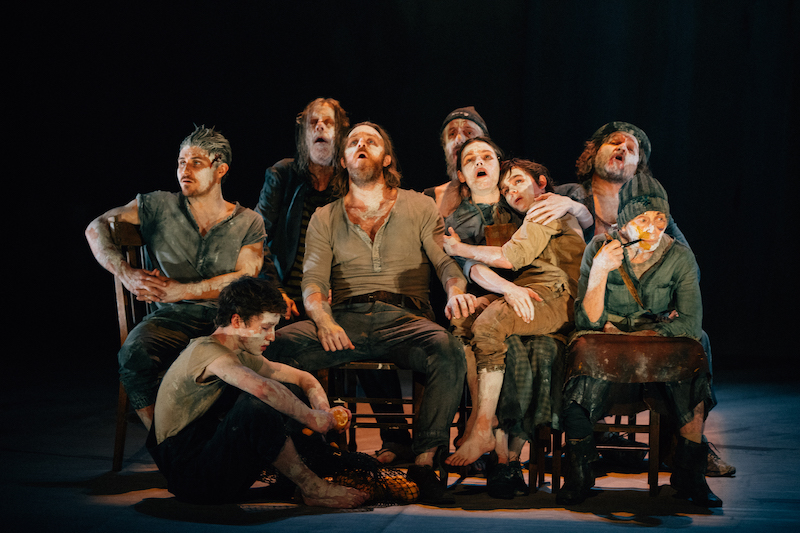 Yet the ever turbulent element of testosterone means that even as the women and the children start to work out ways of communicating, the men are turning increasingly to weapons. While Thornhill encounters one white settler who has formed a relationship with a Dharug woman, it is understood that this is strictly taboo: other ex-cons are openly racist and hostile.
This, with wretched inevitability, leads to a conclusion that is all the more devastating for what we’ve witnessed of the communications between the white and Aboriginal people. The story is made more effective for not taking sides – we are made to understand the fears and pressures weighing down on all involved. Yet there is a point when the crack of gunfire means that the subtlety of all music and words is annihilated. It is difficult not to be made wretched by a scenario which we are all-too-well aware played itself out again and again in the bloody path towards colonisation.
- The Secret River at the National Theatre until 7 September
- Read more reviews on theartsdesk











