Where has this idea come from that Kurt Weill somehow lost his edge or, worse yet, sold out when he headed Stateside? Have the people who perpetrate this nonsense actually heard the Broadway shows? The diversity of subject matter, the individuality of the melodic style, the willingness to be easily assimilated and to embrace and to challenge a tradition that was growing in ambition and sophistication – this was the American Weill. As his wife Lotte Lenya put it: there were never two Weills – “only one, or possibly a thousand”.
To be fair, access to Weill’s American catalogue, in context and in all its glory, has never been easy. With the possible exception of Lady in the Dark and One Touch of Venus the shows are rarely produced and the songs, even classics like “September Song” and “Speak Low”, kind of float in our memories, indelibly imprinted with the gravelly tones of the inimitable Lenya. Songs from a Hotel Bedroom is a laudable attempt to showcase their distinctive qualities and bring them alive for a contemporary audience. The inherent problem, though, is that context is all with some of these numbers and recasting them to serve a different dramatic purpose or even shifting the emphasis just slightly can radically change the way we hear them. Peter Rowe and choreographer Kate Flatt present us here with a slight in-period scenario of love lost and found and lost again, but the emotional tug of this all-new drama – particularly when allied to highly expressive elements of dance (in this case the dark and erotic Tango) – lends one or two of these songs an element of sentimentality that they didn’t previously display. It doesn’t diminish them but inevitably it changes them.
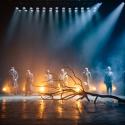
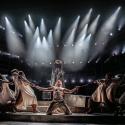
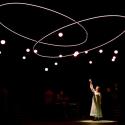
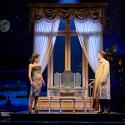
I guess what I’m saying is that their reincarnation in this show doesn’t always highlight their strengths, while the emotional mirror of dance, though fluid and often beautiful in Kate Flatt’s poetic choreography, might have found a riskier, more dangerous dimension in the Tangoing of Amir Giles and Tara Pilbrow. Flatt’s staging is all about fluidity with the diaphanous curtains of Chloë Lamford’s design dividing scenes like filmic wipes. But the poetry is ultimately too lyrical and too winsome, leaving the songs to fend for themselves.
But the songs are, of course, the driving force behind this project and how they are delivered is a measure of its success, or otherwise. James Holmes’s characterful arrangements for versatile septet were to my ears a little too redolent of the Berlin Weill with clarinet, accordion and percussion tilting the timbre towards a Brechtian streetiness. Then there was the credibility or not of Francis Ruffelle, the one-time waif of Les Mis, as a French cabaret singer with more than a touch of wishful thinking in her delivery. I’m afraid that most of the songs defeated her entirely, more often than not sitting awkwardly for her in the reedy soprano part of her voice. Even her big cabaret number – the electric, angst-ridden “Je ne t’aime pas” – didn’t really deliver (who knows the Teresa Stratas recording?) while “Speak Low” and “September Song” (she certainly had the material) somehow failed to engage emotionally and instead left one fretting about how uncomfortably they crossed her vocal breaks.
Her partner in song and romance (neatly a singer/songwriter called Dan Silverman) was Nigel Richards whose vibrant emotive baritone was on another level of accomplishment altogether. His performance of “Westwind” from One Touch of Venus combined great emotional resonance with a wonderful sense of period in the style and he was generous to a fault when the music of the duets demanded that he rein in his big sound to let Ruffelle’s harmonies come through. Too bad her intonation did not repay the gesture. It was not a vocal match made in heaven and I am puzzled by the casting.
Still, those songs – “Here I’ll Stay”, “It Never Was You”, and “To Love You and to Lose You” among the gems – will endure and maybe, just maybe, someone will be encouraged to revive the shows that gave them breath. Love Life (with Alan Jay Lerner) must top the list.
- Songs from a Hotel Bedroom at the Linbury Studios on tonight at 7.45 and tomorrow at 2.30 and 7.45
- Find Kurt Weill on Amazon
Lotte Lenya sings "Mack the Knife":