LJ's dream has come true - she has her very own wine bar. Unfortunately for us, it turns into a bit of a nightmare.
This new musical open on a nostalgic 70s vibe. Tables and chairs fill almost all of Southwark Playhouse's smaller space, a set that conjures memories of the sitcom from that period, Robin's Nest, or the infamous dining room at Fawlty Towers; recent films such as Boiling Point have also found comparable environments fertile ground for exploring the narrow line between comedy and tragedy.
Initially we focus on LJ herself, Mischief theatre alum Nancy Zamit's harassed manager chasing up late staff, letting others go early to deal with domestic crises and being wary of the romance developing between wait staff Maggie and Oliver. We've all met heart of gold bosses like LJ who might be just that bit too soft for the business's good. She's also an example of an ordinary person, the kind of life the writers wish to portray.
 Then, I suspect to the surprise of anyone who hasn't read the programme blurb carefully, the scene plays out again, slightly differently and with the addition of a (failed) audition for Maggie (played by the show's co-creator, Charlie Ryall) who turns out to be a resting actor.
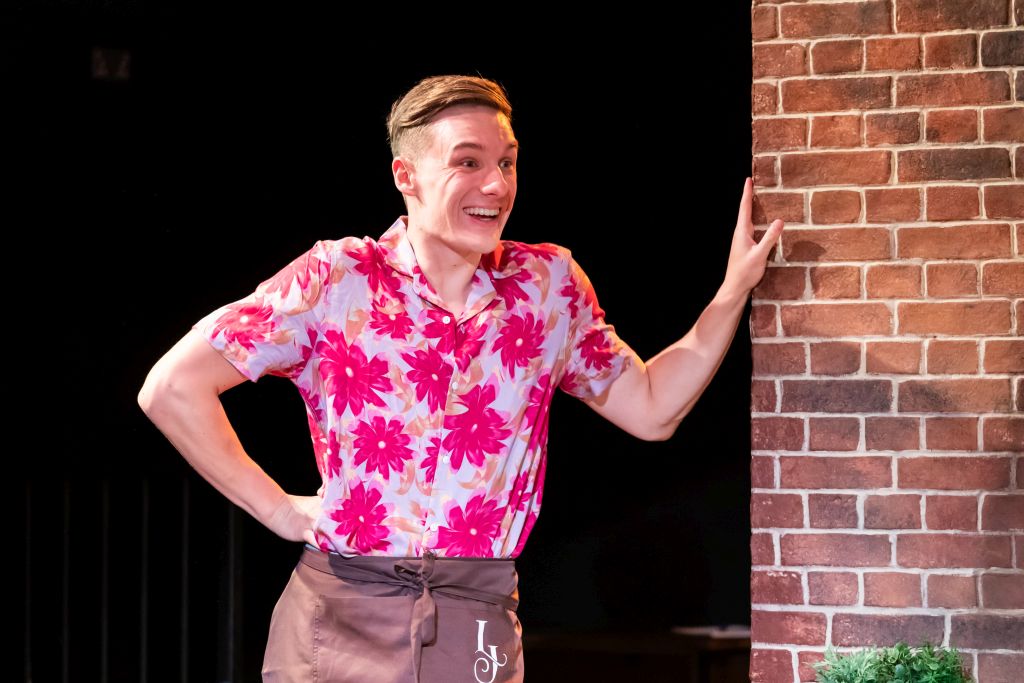
It then happens yet again, slightly differently and this time focused on Joe (Stephen Hoo), a troubled customer. After an interval and, with a sinking heart, we realise that there is caricatured camp boy George (Sam Kipling pictured above), Hungarian chef de partie Eszter (Wendy Morgan), and a preoccupied cat lover, Oliver (Niall Ransome), still to go. Each has their own take on events that become so familiar that the cast are soon literally saying "Blah, blah, blah" to speed us through the set-up scene and get to their own back story so as to flesh out their characters
The musical's structure, for all its innovation, never allows more than a sliver of personality to emerge. The scenes are not long enough for character to develop properly and too much time is spent going over the same ground (often with the exact same words). After our introduction to LJ, we're invested in her ambition, in her kind nature, in her exasperation at the trials she undergoes - but we barely see her again, except as an extra in the others' stories. The paradox becomes apparent: a numbingly long running time of 140 minutes is going to yield less than an hour's worth of the warp and weft of dramatic material. How a musical can be simultaneously far too long and far too short is difficult to explain!
The musical director Richard Baker wrote the tunes and there are some pleasing Sondheimian songs - one repeated refrain required me to actively not think of Company's "Another Hundred People" every time it came up. However, he is not served particularly well by the cast, whose singing is, shall we say, variable. Perhaps that's harsh, but there are so many fine practitioners of musical theatre in London (I've seen hundreds at this venue alone) that one becomes used to excellent vocals, not serviceable ones.
Developing shows like this is tough because there are so many problems to solve before a musical can work on stage. In this one, the multiple flashback structure exacerbates such difficulties. Fold in the fact that every character's story is miserable - some suffering to the point of clinical depression - and that a major plot point is initially disturbing and then very disturbing/farcical (delete to taste), and then, just when you think we're nearing the end, we get a wholly incongruous and unexpected comic song about the delights of owning a cat.
After that, it's a relief to sink that last slug of metaphorical Merlot and leave.