That an action hero should have many lives at his disposal is a given in these days of bullet-proof Bonds and Bournes. Perhaps greatest in his reincarnatory skills however is Richard Hannay. Originally the cerebral hero of John Buchan’s novel The 39 Steps, Hannay was reinvented in an altogether more comedic vein for Hitchcock’s 1935 film, returned for two more celluloid outings (with a new interest in bomb-disposal), and landed a self-titled TV spin-off. Most recently it is his stage exploits that have captivated audiences. Celebrating four years in London’s West End this week, will the tireless Richard Hannay ever run out of steam?
Not at this rate. Maria Aitken’s joyously homespun show (originally conceived for the West Yorkshire Playhouse, and coming to the West End by way of Kilburn’s Tricycle Theatre) takes the many locations, hundreds of actors and several hours of Hitchcock’s film and condenses them into the work of just four actors and a motley collection of props. It’s a joke that still feels remarkably fresh four years on, its endearing make-do-and-mend quality perfectly suited to the improvisatory heroics of Hannay himself.
Thus when Hannay becomes inadvertently “inwolwed” with beguiling spy Annabella Smith, his dash to Scotland following her murder, cross-country pursuit, romantic entanglement and unmasking of dastardly German ringleader The Professor, all take place within a single bare-walled set, requiring not so much leaps of imagination as ocean voyages. It’s a spoof of a spoof, and one that relies absolutely upon the skill and ingenious flexibility of its cast to hit its mark.
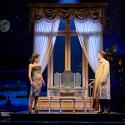
There are some glorious set-pieces. Hannay’s escape from a moving train (a series of packing cases), leap from the Forth Bridge (a ladder) and subsequent pursuit to the wilds of Scotland (rendered in shadow play, complete with vivid biplane attack) are surprisingly compelling, and if not exactly thrilling we gain far more in the comedy of Peter McKintosh’s design than we lose in actual suspense.
Central to Hitchcock’s rewrite, and to the play’s appeal is the unlikely romance between our hero and the plucky Pamela, to whom he becomes handcuffed in a particularly convoluted bit of plotting. Believing him to be a ladykiller of a rather more literal variety, Pamela’s sparring and Hannay’s none-too-chivalrous coaxing fosters some serious tension. This reaches its deliciously coy climax when Pamela attempts to remove her wet stockings while still handcuffed to Hannay, with predictably comedic and unwittingly sexy results.
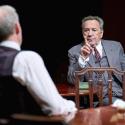
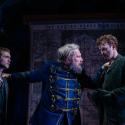
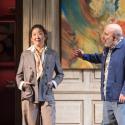
Currently filling Hannay’s Harris Tweeds is David Bark-Jones, a suitably clipped-vowelled and floppy-haired hero, whose ultimate dramatic coup is surely that of pulling off a pencil moustache. He is matched quip for quip by Dianne Pilkington (in all the female roles), though almost overshadowed by the throaty husk of her gloriously overdone German accent as Annabella, and the two provide a gamely sincere focus, setting into relief the endless campery of their two fellow actors (Jeremy Swift and Timothy Speyer) in all the remaining roles.
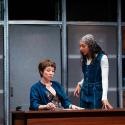
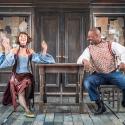
Tackling everything from a Highlands hotelier and his garrulous wife, to a pair of travelling underwear salesmen straight out of the Carry On franchise, with an inexhaustible collection of policemen, villains, vaudeville acts and even gorse bushes between, the two are the core of the show. Sustaining multiple roles, accents and outfits simultaneously leads to some inevitable metatheatrics, the tongue-in-cheek cherry on an unashamedly over-iced cake.
In the dedication for The 39 Steps, Buchan wrote of his desire to create an “aid to cheerfulness” in which the incidents “...defy the probabilities, and march just inside the borders of the possible”. Reworking the story for the stage, Patrick Barlow (from an original concept by Simon Corble and Nobby Dimon) may have jettisoned much of the plot, mood and character, but this flirtation with the improbable, testing of the boundaries of expectation, has been lovingly and elegantly preserved. As aids to cheerfulness go, almost a century later The 39 Steps is still up there with the best.
- Read other West End MOTs on theartsdesk including Dirty Dancing, The Woman in Black, Wicked and Les Misérables
- Find John Buchan's original novel on Amazon
- Visit The 39 Steps official website