

The National Theatre is meant to represent the whole nation – and not just the metropolitan middle classes. So it’s really good to see that Beth Steel – who comes from an East Midlands working-class background and was once writer in residence at this flagship venue – is having her latest play staged here in the Dorfman space. Like The House of Shades, her Almeida Theatre hit from 2022, Till the Stars Come Down is set in Nottinghamshire, in the former mining town of Mansfield, and features a working-class wedding. Although it’s a laugh-out-loud comedy, it does – like the summer’s day on which it takes place – have its darker shadows.
The plot covers the day and night of local woman Sylvia’s marriage to Marek, a Polish migrant, and begins with her sisters – Hazel and Maggie – helping her get ready with make up and dressing, while her Aunty Carol bosses everyone around and sees to it that the buck's fizz is on hand. Amid a lot of laughs, and some vivid comedy, the family situation is rapidly sketched out: Hazel’s marriage to John, which has produced two children, is on the rocks, and he is currently jobless. Maggie is the sister who has recently moved away, the insider turned outsider, while the bride’s father, widower Tony, a former miner, is estranged from his brother Pete.
As the wedding party takes off so does the play: there is talking, drinking, feasting, dancing, vomiting, fighting, shagging and arguing. A key dispute is Marek’s acceptance into this working-class family. Although he is successful, and even offers John a job, he is resented by both the men and the women (with the obvious exception of Sylvia who is caught in the middle). Now that the mines are closed the main source of work are distribution warehouses and other post-industrial services, whose best supervisors are often Eastern Europeans. The bigotry of the women against these newcomers is highlighted, but there’s also a strong image of Poles as charmingly convivial vodka-drinkers and sex machines.
The play is inspired by WH Auden’s poem “Death’s Echo”, which gives the drama its title and whose final lines – “dance, dance, dance till you drop” – fuel the festivities, and whose “desires of the heart” are expressed in the central tragedies of the frustrated female characters. At the same time, the situation of three sisters obviously recalls Chekhov’s 1900 drama, and the often expressed theme of change, longing for change as well as fear of change, runs through the play like a dribble of warm beer. Although there are some frantically funny moments, there is also a real ache that hurts almost all of the characters.
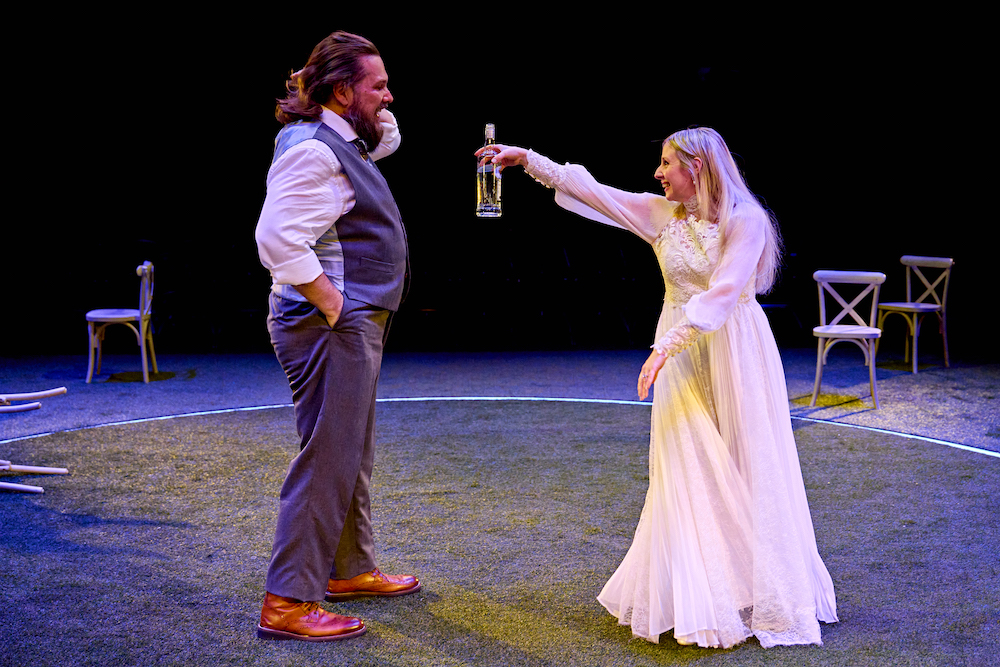 Bijan Sheibani’s energetic production, which openly solicits audience participation with its singing (Marek’s wonderful version of Andy Williams’s “Can’t Take My Eyes Off You”), clapping and dancing, is a populist delight – and its exhilarating moments will thrill anyone who sees this show. Carol’s barrage of vulgar and sarcastic one-liners is convulsively funny, and the greater theme of our place as humans in an unfeeling cosmos – symbolised by a sky lantern, a toy space ship, the planets and the stars – is beautifully directed, and neatly designed by Samal Blak, whose simple green-lawn set has a revolve which makes this in-the-round show easy viewing.
The richness of Steel’s text, which is most acute in its savage climax and most perceptive and observant in its depiction of the emotions of Silvia, Hazel and Maggie, paints a complete picture of an instantly recognisable family. As the wedding day turns into night, the uglier aspects of sexual disappointment, unrequited love and the discovery of falsehoods roar out of the dark with a dramatic intensity that strikes hard at the guts. But, wildly witty as it is, this celebration of working-class Midlands women means that the play swerves a little too to close to the grotesque in its picture of potty mouths, ignorance and bigotry. It does, however, glory in its own verbal vigour as a thoroughly female-led state of the nation play.
There are countless hilarious incidents which delight and amaze. And yet; and yet. Despite the wonderful warmth of Sheibani’s production there is something just a bit uncomfortable about a London audience laughing uproariously at these working-class people. Isn’t this another example of cultural tourism? An evening’s holiday in other people’s misery? But, hey, who cares – let’s just have a laugh, eh? There is also something mildly distasteful about the use of a false accusation of sexual assault as the central plot device of the second half of the play. In reality, such lies by women are very rare, so repeating and stressing them in fiction only perpetuates very old assumptions and prejudices, which is surely enough to make campaigners against violence against women and girls despair. But hey, who cares when you’re having a good time?
On the other hand, Sheibani is excellent at making the most of the visual aspects of theatre: when Sylvia can’t get into her wedding dress and has to use her dead mother’s old wedding dress, her father thinks for a moment that he’s seen a ghost from the past. This stage image is delivered in a masterly way. And yet; and yet. The more you think about it the less bright shines the show. Somehow I couldn’t quite shake off the feeling that Marek is one-dimensional, essentially just a funny foreigner, and that the women – despite the article in the programme that warns against the clichés of depicting ex-mining towns – are often stereotypical. And, however enjoyable to watch, Carol is a monstrous exaggeration.
So despite the implied criticism of government cuts to the NHS and mention of the Miners’ Strike, whose scars don’t heal, the comic brio of the play often overcomes the more interesting aspects of the characters, their real lives whose depths are too often sacrificed at the altar of easy banter. Still, you cannot fault a terrific cast: Sinead Matthews’s Sylvia and Marc Wooton’s Marek (both pictured above) give a good account of love in adversity, although I’m not too sure about his “Polish” accent or about the absence of his work mates. Lucy Black (Hazel) and Lisa McGrillis (Maggie) are both really convincing as siblings, while Lorraine Ashbourne’s Carol must be the comic creation of the year. Although the other men are marginalised, mention must be made of Alan Williams’s Tony. If you can forgive the stereotyping, and the late arrival of heartbreak, this is a great night out which – whatever my doubts about its populism – will surely scoop awards.











