This show feels like an end-of-the-exams party, and in a way that’s exactly what it is. If the fruits of Emma Rice’s short tenure as Artistic Director at the Globe were a series of tests that she is deemed to have failed, then Tristan & Yseult, a revival of an early hit devised for the company Kneehigh, is her parting two-fingered salute. For here writ-large are the rowdiness and irreverence and – heavens above – microphones and electric guitar that so offended a certain faction of the board that it was persuaded to terminate Rice’s contract, despite having hired her precisely because of her iconoclastic approach to classic texts.
Tristan & Yseult has garnered something close to a cult following since its first airing in a roofless Cornish castle 14 years ago. Its revival follows a period of international touring and it arrives on Bankside as a poignant bookend to Rice’s stint, its groundling-embracing humour greeted with whoops and cheers, and not only by the several hundred sturdy souls who paid £5 to go without a seat.
In this take on the medieval legend, Tristan, a young Breton on a diplomatic mission to Cornwall, slays the Irish invader Morholt and is sent by the Cornish King Mark to Ireland to bring back Morholt’s sister, Yseult, to be his queen. Mission almost accomplished, on the ship home both Tristan and Yseult accidentally drink a love potion. The royal wedding goes ahead as planned, but we know what can happen when there are three in a marriage, and it’s not pretty. Carl Grose and Anna Maria Murphy’s script, partly in iambic pentameter, alternately mocks the fate of the tragic lovers and milks it. Stu Barker’s music follows suit – most of it played live by a roaming ensemble – lurching back and forth from Daft Punk and Pharrell Williams to lilting Celtic folk and Wagner.
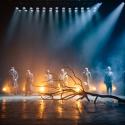
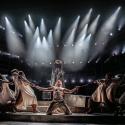
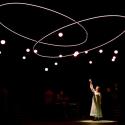
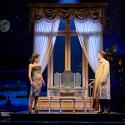
Even the stage design (by the late Bill Mitchell) is a car crash of styles, clean graphic lines and hydraulic platforms jarring with messy mayhem. The multi-tasking chorus (“The Unloved”, dressed in anoraks and nerdy glasses) scoot about like the balaclava’d sperm in the Woody Allen sketch, handing out random props and commenting on the action in unison. There are some mean instrumentalists among them, and some eye-popping body poppers too.
Dominic Marsh is a convincingly Gallic Tristan, a reckless romantic, while Hannah Vassallo (pictured above with Marsh) makes an impishly sexy Yseult. Mike Shepherd brings a touching humanity to King Mark, and Kirsty Woodward makes an interesting case for the apocryphal Whitehands, whose crisply cynical commentary on sexual attraction from the viewpoint of the unloved hangs over the piece like a cloud of acid rain. Most remarkable of all is the performance of Niall Ashdown as Yseult’s maid Brangian, who takes what could have been a crude panto role into a place of delicate yet hilarious pathos.
If Tristan & Yseult has a fault, it’s that it’s all ballast and no cargo. The slender story is told with terrific visual and musical élan but scant verbal poetry – a balance suited to Kneehigh's back-of-a-cart origins but perhaps less to Shakespeare’s Globe. It’s significant that the highly emotional final minutes of the piece are entirely wordless. It’s Wagner’s Prelude and Liebestod, issuing from a scratchy onstage record player, that carries the day.