As China and the US arm-wrestle for world domination in everything from trade to military power, we find ourselves in the throes of a space race again. After China became the first nation to land on the dark side of the moon this January, it seems particularly apt to revisit The Twilight Zone in all its retro glory to examine what aliens can – among other things – reveal to us about our humanity.
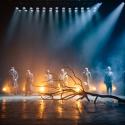
The continual osmotic reaction between what happens on a stage and the news headlines outside the theatre means that this return of a production first seen at the Almeida in 2017, now transferred to the West End, is possibly therefore primed to work better in 2019. The wit and style of director Richard Jones are in no doubt from the start, as the cast recreating this black-and-white TV hit face us in a gorgeous array of monochrome costumes ranging from leopard-skin glamour to zipper-jacket chic.
Anne Washburn’s taut, humorous script interweaves eight out of the 156 episodes that featured in the iconic late Fifties/early Sixties TV series. What’s so masterful about the production is the way it builds a gentle crescendo of weirdness, starting with a story about a busload of passengers stranded in a greasy spoon, and ending in a potent Romeo and Juliet-via-cryogenics love story.
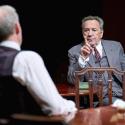
The humour alone is a sufficient sweetener to make this extra-terrestrial entertainment a theatrical treat, but a drama from a powerhouse like the Almeida needs to deal with more significant questions than how many mutant limbs any character may have. It rises to that challenge, because – in the last story especially – it makes manifest that what here is ascribed to interplanetary mystery is in fact a metaphor for lack of human understanding, whether it is about fear or love. In the first episode, in which the initial moment of unease arises, six passengers are dumped in a greasy spoon due to bad weather, only to discover that there are seven of them. Instantly, there is a light frisson about who might be the outsider – a potent analogy for modern politics that here becomes a deftly amusing sketch about how we assert ourselves so that we belong when normality is threatened. Even at this point, there is a division between the dubious role of the police officer and the perceptions of the bewildered. Whether it’s the flamboyant outrage of the wonderfully arresting Matthew Steer as the eccentric in the bar, or the flirtation of Natasha J Barnes’s charismatic dancer, we are aware that this is ultimately a narrative about conformity.
While the evening lends itself to such analogies, it is perhaps weakest in the episode in the second half in which the cast – embodying characters from the same year as the missile crisis – rail against neighbours who won’t let them into their nuclear shelter. It’s too much of a rupture from the gently humorous narrative of alienation that successfully animates the first half, and, as the characters fret increasingly desperately about their lack of preparedness, feels, on this occasion, like too obvious a reference to our own political plight.
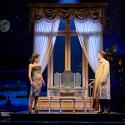
Despite such unevenness in tone, one of the constant delights of the evening is the production, whether it’s Nicky Gillibrand’s ingenious made-for-black-and-white TV costumes or Paul Steinberg’s lovingly retro set, complete with swirling vortex-style umbrellas. Richard Wiseman and Will Houston’s illusions provide constant, stylish entertainment too, not least in the running motif of the surprise cigarette that manifests itself between fingertips, poised for a smoke, every time normality is threatened.
And it would take an alien with a heart of kryptonite to fail to be moved by the final story in which an astronaut – sent on a 50-year space mission – realises he is in love with a NASA worker whom he is doomed not to meet again till she is an old woman. The execution of this story is absolutely pitch perfect, right down to the final bitter twist. It’s proof that no matter how strange the universe around us is, perhaps the strangest and most inexplicable thing of all will always be love – though those cigarettes are pretty engagingly freaky, too. Definitely worth the rocket ride.
- The Twilight Zone at the Ambassadors Theatre until 1 June
- More theatre reviews on theartsdesk