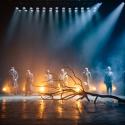
There's a clear theme running through this year's autumn programme at the Southwark Playhouse: new musicals with strong feminist roots. Wasted, centred on the Bronte siblings, is landing later this month, but first there's Unexpected Joy, written by Bill Russell and composed by Janet Hood, and directed by Amy Anders Corcoran. First seen Off Broadway, this is a solid, dependable sort of show that doesn't justify the first word of its title.
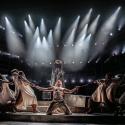
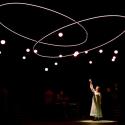
The eponymous Joy (Janet Fullerlove) is a hippy musician straight out of the '60s, wafting about the stage in kaftans and shawls (the costume design is lovely, if a little limited). She's putting together a memorial concert to mark a year since the death of her longtime partner in life and love, and she wants daughter Rainbow (or Rachel, as she prefers to be known these days, played by Jodie Jacobs) and granddaughter Tamara (Kelly Sweeney) to join her. Vignettes from the gig are sprinkled neatly throughout the show, but Joy's grand plan is imperilled from the get-go: she's getting married to Lou, a fact that's sure to upset her daughter, whose husband is a radical preacher and who never quite forgave her mother and father for refusing to tie the knot. There's one other tiny problem: Lou is a woman, played by Melanie Marshall.
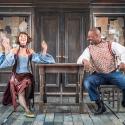
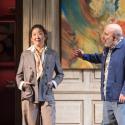
 Marshall is superb, although the writers risk painting her into the stereotype of the sassy black woman, particularly as she's the only actor of colour in the production. Sweeney (pictured right) is making her professional debut, but you'd never know it: she pitches Tamara's wide-eyed admiration of her grandmother and her core of steel perfectly, and my God, can she sing. Her vocals are bested only by her onstage mother, who pulls a blinder on "You Are my Worst Nightmare", which expresses Lou and Rachel's absolute contempt for each other.
Jacobs has a lot of solos that never seem to go anywhere, and, like all the characters, her development over the show is blurred, but she does a lot with Rachel, managing to endear us to a supremely unsympathetic character. Fullerlove is far more believable as a mother and grandmother than she is as a lover, but she comes into her own in the second act. "I Don't Want to Get Married" is bluesy and ballsy, full of prescient lines about the cultural impact of gay marriage. "I don't want to get married just because we can," Fullerlove sings while rolling a near-professional standard blunt. Now that's multitasking.
Some lines sparkle: "I am the one lesbian in America who never wanted kids," Lou proclaims, which gets a big laugh. But the dialogue can be clunky, often sagging under the weight of exposition and awkwardly out of step with how people actually speak: teenage Tamara confides in her grandmother that she's "really hating on Mom at the moment". The songs are better, reminiscent of Fun Home or the work of Pasek and Paul (the duo behind The Greatest Showman and the Oscar-winning main track from La La Land).
They're at their best when all four actors sing together, a trump card which isn't played enough. Sometimes it feels as if the music is secondary to the action rather than woven seamlessly into it, but maybe that's the point. The fact that they're all singers isn't what brings these four women together; it's that they're all family, like it or not (and Rachel and Lou are firmly on the "not" side). The message is, like the rest of the show, somewhat oversimplified, and also a bit problematic: we can all find some common ground if we look hard enough. This may have been a fitting sentiment in the '60s, which is when the song was written within the context of the show, but it seems a little tired now.
Clocking in at a neat hour-and-three-quarters, Unexpected Joy never drags, and scarcely puts a foot wrong. It's just that you can see every step coming a mile off.