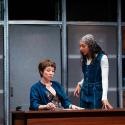
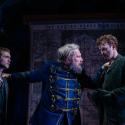
Since when has new writing become so passionless? Mike Bartlett is one of the country’s premiere playwrights and his new play, Unicorn, is about radical sexuality and desire. It’s already made a big splash by being put straight on in the West End, yet the experience of watching it feels like a real turn off. It’s a masterclass of bad writing and unemotional acting.
And this despite a star cast, led by Nicola Walker and Stephen Mangan, which means fans of Abi Morgan’s BBC series The Split are buying tickets in droves. They will be delighted by some of Bartlett’s spiky dialogues, although I think the show lacks wit, and the most memorable exchanges are buried in acres of banalities and declarative statements about the way we live now. I lost count of how often I thought: who actually talks like this?
In this marriage story, the key word is throuple, not couple. It begins with Polly (Walker), a poet who teaches creative writing, having a drink with 28-year-old student Kate, who loves her work and also writes. Polly is clearly attracted to the younger woman. Later, when she tells her husband Nick (Mangan), an ENT doctor, that their relationship lacks sparkle (they’ve been married for a while and have two children, who are oddly absent), she suggests experimenting with a threesome. While Nick finds the experience nerve-wracking and shaming, Kate - improbably enough - is completely cool about it.
The first half of the play explores this attempt at reviving the sexual passions of Nick and Polly’s marriage, and the second half complicates the narrative, but losing focus and precision as the evening drags on. Bartlett and his team are clearly aiming to provoke the audience: look at your own relationships, they say, wouldn’t they benefit from some radical sexual healing? It’s not a bad question, yet Unicorn - whose title refers to the fantastical notion of a younger woman willing to behave like Kate does - seems disappointingly reticent, despite some explicit talk and vulgar expressions, in exploring the reality of a throuple. Monogamy rules - by default.
Although the unwilling Nick gets some very good lines about the idea of welcoming another person into the marital bed, with recognizable emotions, the women seem to have been written as clichéd male fantasies. The dialogues never really grapple with genuine emotional material, with deep awkwardness, anger or jealousy. The characters live in a world devoid of feeling. In attempting to be up-to-date, Bartlett ignores the often painful, and yes sometimes joyful, history of sexual experimentation since the 1960s. This blindness about past experiences wouldn’t matter if the writing was more imaginative, and more profound, but it’s not so it does.
Worst of all, a lot of the writing foregrounds boring material on life today instead of a deeply felt examination of truthful emotions. So we get to hear some standard comments about modern marriage, masculinity, couples and capitalism, plus some stuff about She-Ra, old-style relationships and the digital world. Yawn, yawn, yawn. The obvious differences between the older couple and the younger single are patiently explained, yawn again, but none of the characters are convincing. There’s no sense that Polly really is a poet, nor that Nick actually works as a doctor, or that they really have kids. Kate is clearly a cardboard dream image.
So Unicorn might split (pun intended) audiences into those that approve and those that disapprove of sexual experimentation, but the play lacks any sense of danger to achieve this. While it’s quite successful as a fitfully funny comedy of manners, it is so deeply middle class that, desoite its pretensions, it never does more than put a toe in the shark-infested waters of real desire. At its centre is the family, the middle-class family, and while this may be threatened, it cannot be destroyed. Bartlett gets himself into so many plot twists to preserve the family that any sense of radical surprise gradually evaporates. What remains is a safe evening for safe West End audiences.
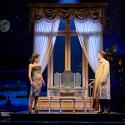
Miriam Buether’s design features sofas and benches under an arch, and scene changes feature jaunty versions of “Daisy Bell”, pointing out the prevalence of Victorian mores. Directed by James Macdonald - who also directed the original production of Bartlett’s Cock in 2009 - Unicorn offers an evening with sporadic laugh-out-loud jokes, and a chance to see starry actors. Walker and Mangan definitely have an onstage affinity, and empathy, which makes their relationship vaguely credible. She is good at looking frustrated, he at being put-upon. She is energetically loquacious, he is worried and aggressive. Then there’s Kate, played by The Crown’s Erin Doherty, as a mouthy Cockney, both lively and wise, who does her best with an improbable role.
The unicorn is meant to be a very rare beast, a creature to be imagined rather than met, but this show - which smoothly reaffirms the idea of the primacy of family, and pictures desire as wordy and passionless - is something much more ordinary: a badly thought-out play.