Now look here, Giles Coren: immersion in a great play well acted can send you out of the theatre feeling very different from when you entered it – and I don’t mean stressed-out. In this case, light as air and sad as hell, simultaneously. You may still find it funny or contrived. Yet these things are true: when in 1976 Arthur Kopit, visiting his stroke-incapacitated father in hospital, met three strong women there, he transformed their experiences into a superbly structured, strikingly phrased poetic drama. And now, over 40 years later, Juliet Stevenson and the director who helped her to make such a wonder out of Beckett’s Happy Days, Natalie Abrahami, have returned to the text with a discombobulating mix of sympathy, fantasy and discipline.
Whether everyone responds to a bold experiment as tearfully as I did may depend partly on experience of what havoc a stroke can wreak on a person and his or her family. But theatrical alchemy is about more than simply registering the situation – which Kopit also did in a moving long introduction reproduced in the Young Vic’s programme-text. He recalls how the oldest of the three women he met could see summer outside the window, put all her might in a speech therapy session into coming out with the word “winter” to identify it, “looked over at where I sat and shook her head in dismay, then laughed and said ‘This is really nuts, isn’t it?’"
 The line goes into the play – originally a radio drama, powerfully adapted by Kopit for the stage – along with other seemingly ordinary sentences that may seem like nothing out of context but which cut to the quick (“I’ll come back to that”, “the death thing, it comes in… I can’t get it out till it’s ready”, “just can’t bring myself to give it up”). If you read the introduction, does the drama turn out surplus to need? Not at all; like all great art, it gives form and content to the full, dizzying experience from within and without. Stevenson’s Emily Stilson sees the medical staff around her, when they come into some kind of focus, as crazy, unable to understand what’s at first making sense in her head; but we also see how her speech appears to them.
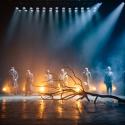
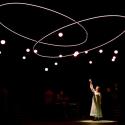
Was it a mistake to embody the key element – the “wings” – in the production? The fact that Mrs Stilson, like one of her role models, was an aviator and wing walker could lead to facile metaphor; but this, too, is rich and ambiguous in Stevenson’s and Abrahami’s realisation. Haltered throughout, the protagonist can float and soar in her dreams (pictured above) but also be turned upside down in mid air, unable to touch the ground or reach reality. Having been marooned inside the central oblong stage while others try to get through to her from outside – she gives them the replies she thinks they want, but they hear something else – she’s also hovering outside it, attempting to plant her feet on the ground, in one seminal scene where a doctor (David Emmings) attempts to draw speech and identification from her. Who would have thought that as simple an object as a toothbrush could lead to such agonising drama?
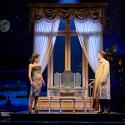
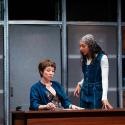
Stevenson moves from the delirium of the catastrophe though detachment and lacerating anger to steady rooting, and in this Lorna Brown’s sympathetic speech therapist Amy – the first to call her “Emily” rather than “Mrs Stilson” – is an essential questioner; it’s typical of Kopit’s sensitivity that instead of showing us the heroine regaining knowledge of a plane on a visit to Rhinebeck with her son, he has her describe it to her new friend. Poignant humour surfaces between these two, and there’s a much-needed divertissement in a therapy session, with delicate cameos from Nicholas Gasson, Mary Sheen and Kelle Bryan (pictured below, with Brown, left, and Stevenson). Ultimately, though, this is more than just a drama about the difficult subject of aphasia, speech disorder. Ultimately it turns into a final monologue about what is perhaps the biggest issue of all for any dramatist: fear of death. And though in the initial catastrophe sequence I fretted that the sound design from Gareth Fry and Michael Levine's visuals might overwhelm the theme – Stevenson is miked, her usually ineffable multi-octaved delivery sometimes muddied – they have become essential companions by that point. We’re as reluctant to leave them behind as Emily is to enter something “empty, black and endless” if she flies away from “this one small silly street in this one, small town”. We leave, like her, on wings. And with immense gratitude to Kopit for providing, like Beckett, a truly great role for an older woman.