Forget write what you know: writing what you feel would seem to be the impetus driving Ella Hickson's often-startling The Writer, a broadside from the trenches that takes no prisoners, least of all the audience. Demanding and sometimes irritating, the play exerts a brute force across nearly two hours (no interval) thanks to a galvanic performance from Romola Garai and an impassioned production from Blanche McIntyre that powers through remarks like "you are not skewed toward a systemic awareness" (!).
If comparable talk of "intersectionality and voicelessness" leaves you numb, The Writer may not be your theatrical cuppa. But it's hard to imagine a piece of new writing better suited to the Almeida Theatre aesthetic, both in its stripped-back visuals (following on directly from the recent Summer and Smoke at this address) and in an anger-inflected playfulness that grabs the attention and holds it, even when its meta-theatricality gets too tricksy by half. 
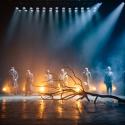
Playing a creator all but ready to tear herself apart from the inside, Garai constitutes the crucial if late-arriving fulcrum of a play that wants to dismantle the patriarchy as fully as Anna Fleischle's clever designs keep returning us to the Almeida space itself, stagehands at the ready.
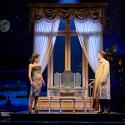
The striking opening scene, performed house lights up, falls to Lara Rossi, as a young writer who bursts through the audience and on to the stage, to take issue with a director (Sam West) who would appear to believe in both the objectification of women and the commodification of art; Rossi, meanwhile, uses "fibrillate" as a verb and argues on behalf of theatre that matters. Amongst the fare that sparks her fury are plays involving babies and dogs (spoiler: The Writer later brings on an actual baby) and, against the odds, the much-travelled Royal Court play Posh. That the author of Posh, Laura Wade, is in fact West's real-life partner amplifies the dizzying hall of mirrors through which the play makes its way. (Pictured above: Lara Rossi, Sam West)
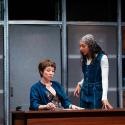
 When Garai does appear, she is identified as the author of the earlier scene who turns out to be having issues of her own with a director (Michael Gould) who is big on dramaturgical closure and fond of adjectives like "ranty". Before long, Fleischle's set is being re-erected (flimsily so, on purpose) and Garai is off on her alternately explosive and exhausted way. Whether meant to be self-penned or actually lived (as far as a piece of fiction will allow), the experience of Garai-as-writer is told in terms that jettison the very naturalism favoured by Gould; one of them, a sylvan fantasia involving (of all mythical figures) Semele, pushes at the boundaries of a play that has elasticity built into its very being.
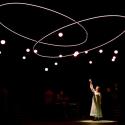
It's thrilling to see a writer speaking up to her audience and embracing the commonplace, only to upend it. Talk of the "holy fire" that is art and the lovely if occasional shadow play of Richard Howell's lighting devolve into an extended same-sex encounter between Garai and Rossi that has fun with everyday speech: "Can I go down on you?" one asks, only to be met with the reply, "I'm doing emails." The quotidian and the mystical pass the baton to one another in an origami-like theatrical construct made to order for its current home, though I do wonder how (and where) The Writer would travel from here. If anything is missing amidst the various screeds that propel Hickson forward, it's the sort of deep emotional connection that might enlarge our response. "You weren't moved?" Garai asks at one point, to which one can only reply: moved, no, but very much intrigued. yes.