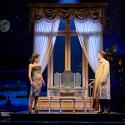
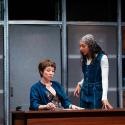
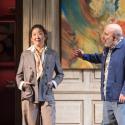
In 2014, Pomona stormed the Orange Tree, turning the previously staid venue into a place of both lauded theatre revolution and disgruntled walkouts. Could Alistair McDowall repeat the feat at the more progressive Royal Court?
X should certainly prove as divisive, with a labyrinthine, genre-hopping structure even less resistant to easy answers. Pinning this play down is like trying to decipher clues to a cryptic crossword whose grid has just morphed into a fish. The entire first half is dismantled by the second, innocuous exchanges shape-shift repeatedly, and we lose our anchors, one by one, along with McDowall’s characters. If ultimately a more cerebral than visceral experience, it’s a singular leap into the unknown.
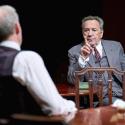
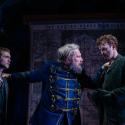
We’re in deep, dark space, stranded with a team of scientists on Pluto – originally designated Planet X, and since downgraded to dwarf planet. The Americans have snapped up Mars, leaving us Brits with icy nothingness at the edge of the Solar System. The research base has lost contact with the ecologically devastated Earth, and there’s nothing to do but wait. Jittery Gilda (Jessica Raine), thrust unwillingly into leadership, attempts to marshal her team: belligerent Clark (James Harkness), analytical Cole (Rudi Dharmalingam, pictured below with Harkness) and pragmatic Mattie (Ria Zmitrowicz). But veteran Ray (Darrell D’Silva) believes they’re not alone out here. What’s more alarming: invasion or isolation?
 So far, so Kubrickian sci-fi, though already jostling for space with claustrophobic student flatshare and workplace comedy (there’s even a tax avoidance joke – who knew a futuristic space play could be topical?). Three weeks’ radio silence stretches into months, maybe years. The digital clock is glitching, it’s always dark on Pluto, and ceaseless tedium becomes a prickling horror on this base designed to live forever. Cole futilely tries to create an algorithm for time – one of many “x”s; Clark, who touched the past when he felt one of the last living trees as a boy, now believes only in the present; Mattie masturbates three times a day to maintain some kind of structure. Glinda eats breakfast cereal at all hours, and, when she can’t sleep, listens to a recording of the nothingness outside – somehow more real than the computerised nothingness within.
McDowall’s dystopian vision is dominated by that loss of the organic and tangible, the slow creep of machines, life experienced through 1s and 0s. Is something real only if we can hold it, smell it, taste it? Do we need that to retain a sense of self, or can we rely on memory, mythology and emotional response? McDowall undercuts everything we see and hear, but his version of Florian Zeller’s temporal slipperiness relies on too much exposition-heavy and studied set-up. It’s meatier in retrospect, but that only works if you’re viewing the play on a loop (appropriate, perhaps). Like the crew, we are left waiting, indefinitely.
 The tonal lurches, elliptical characterisation and linguistic deconstruction create an engagement challenge that Vicky Featherstone’s production can’t quite overcome. Raine’s Gilda (pictured above left), anxious, prickly, forever chewing on her hair, suffers a very British breakdown – “We’re all a bit fraught!” she snaps, with admirable understatement – but because Gilda is ill-defined, her loss of self is less affecting. The supporting cast is similarly hamstrung, and none entirely nail the quirky comedy, but D’Silva sells Ray’s grief for a lost world, Dharmalingam and Clark unravel convincingly, and Zmitrowicz and Amber Fernée are, as required, both natural and inscrutable.
References to parenthood, love, sickness and mortality are more thought-provoking than moving, but there are moments that haunt: a child’s voice; a dangling pair of legs; a painted window; the demonic glow of unreliable red digits; the desperate assertion that “You don’t forget something like that”. Merle Hensel’s greenish-grey, queasily off-kilter pod is dominated by the yawning mouth of a window to blackness, and Nick Powell’s nerve-jangling soundscape feels like the internal scream of someone tumbling into that void. Surrendering to it, rather than battling for a linear reading, makes this a more rewarding experience, but though McDowall boldly goes where no play has gone before, he may not take all his audience with him.