The issue of public inquiries into the conduct of the military is in the headlines again, with a current focus on Northern Ireland, but at the centre of screenwriter Robert Jones’s Danny Boy was the attempt to find British soldiers guilty of war crimes in Iraq. The Battle of Danny Boy (it was the name of an Army checkpoint) took place on 14 May 2004, when a British patrol was ambushed by fighters of the so-called Mahdi Army.
After allegations were made that British troops had murdered 20 Iraqi prisoners and tortured others, the Al-Sweady Public Inquiry was set up to investigate. One of the soldiers implicated in the affair was Lance Corporal Brian Wood, who’d been awarded the Military Cross for bravery for his conduct in the battle.
 Jones (Murder, Secret State, The Bill etc) and director Dan Miller have used Wood’s true story as a crucible in which to examine the stresses of combat and its effects on soldiers and their families, while also posing questions about how it’s possible to make rational judgements about the chaos of warfare in the bureaucratic setting of a tribunal. Anthony Boyle (Derry Girls, Patrick Melrose) did an excellent job as Wood, conveying his patriotic pride in doing a job for Queen and country, then being barely able to cope with the shadow of the inquiry looming over him while his young son (Tommy Finnegan) was telling him his schoolmates think his dad’s a murderer.
The fact that Wood’s experiences had left him with PTSD heaped an extra load onto his shoulders, and there was a gruelling episode where his wife Lucy (Leah McNamara, excellent) was shocked to find her husband crawling across their lawn in the dark, banging his head on the turf. Perhaps they ought to strike a special medal for Army wives.
There were powerful scenes, too, between Wood and his father Gavin (Alex Ferns). The Woods had been a military family for generations, and Gavin, who’d served in Northern Ireland, had brought his son up in the old pre-enlightenment style where you “kept it all in house” and didn’t talk about the terrors and traumas of the Army life. Considerations of “mental health” weren’t on the agenda.
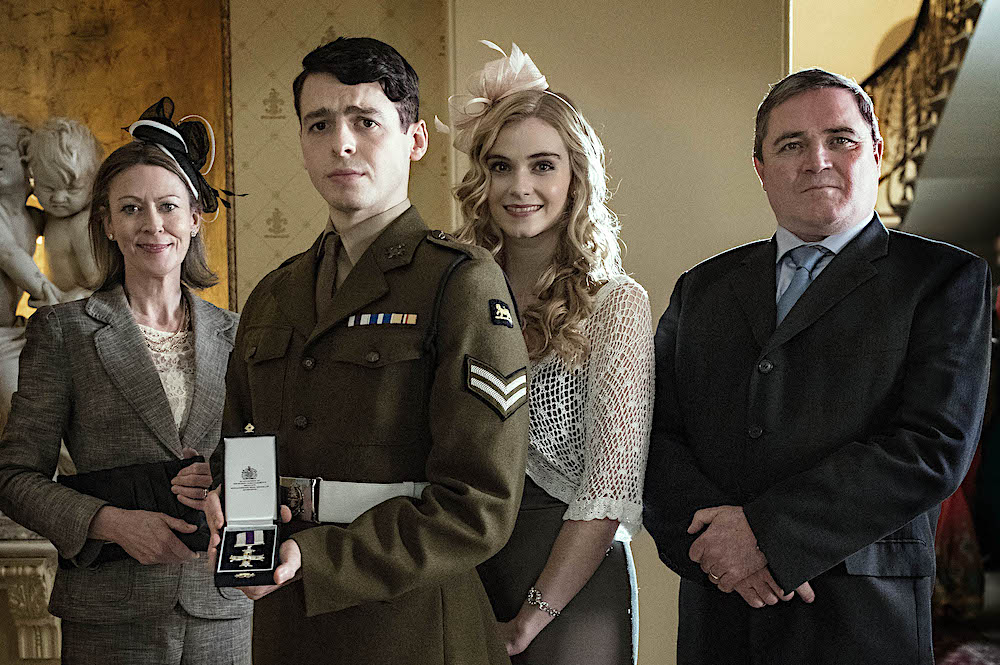
The film didn’t attempt to make a judgement on the soldiers’ conduct (Brian Wood himself acted as “military consultant” on the film), but Phil Shiner, from law firm Public Interest Lawyers, led the charge to get the soldiers convicted, and had no doubts that they deserved to feel the full weight of the law. “British soldiers get away with murder,” declared Shiner, who had successfully brought the Ministry of Defence to account for the 2003 death of Baha Mousa in British Army custody in Basra (pictured below, Wood and family).
 This was where Danny Boy came unstuck. Watching Toby Jones’s performance as Shiner, we were seemingly invited to conclude that he was a man of conscience who sincerely believed in getting justice for the Iraqis, although perhaps a little too zealous in his work. But how did he manage to overlook the crucial evidence that proved that the dead Iraqis were all fighters for the Mahdi Army, rather than the innocent farmers he was making them out to be?
Shiner’s campaign imploded when the soldiers were cleared of unlawful killing and torture, these allegations found to have been “wholly without foundation and entirely the product of deliberate lies, reckless speculation and ingrained hostility”. An on-screen caption told us that Shiner was struck off after a tribunal found “evidence of errors and misconduct”, which was putting it mildly. He was found guilty of 22 misconduct charges. As The Times wrote: “He admitted paying middlemen to find Iraqi compensation claimants who submitted fictitious witness statements … His law firm had received millions in legal aid to sue the Ministry of Defence over the fabricated allegations.”
Shiner’s ignominy is hardly a secret, and glossing lightly over it left the drama fatally lop-sided. As agonising as Wood's experiences were, the elephant in the room was the question of how a five-year inquiry, costing £30m and based on fabricated evidence, could ever have been allowed to proceed?