I’ve long held the belief that much of what is wrong with the human race stems directly or indirectly from religion. But while this subject has had something of a renaissance in recent years, thanks to the likes of Christopher Hitchens and Richard Dawkins, the absolutely central story of the global banishment of the Goddess - in all her many forms - has largely remained untold. So it was with some excitement that I sat down to watch the first instalment of this three-part documentary series.
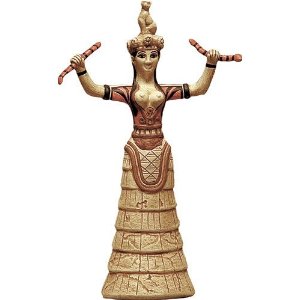
Historian Bettany Hughes' ebullience about her subject was immediately palpable. In the opening minutes she showed us a striking statuette of a bare-breasted woman who looked like she was posing Beyoncé-like for an album cover shoot. I don’t say this to deride this modest immodest figurine of a Minoan snake goddess (pictured below), but to suggest it exuded a confidence and overt sexuality we’ve come to associate with 21st-century female pop stars, rather than a Cretan woman from 1,600 years BC.
Representations of the female form make up the majority of unearthed sculptures from the past 30,000 years
Unsurprisingly, many such explicitly sexual figurines were thought obscene and barbaric by the Victorians and so weren’t originally displayed in museums. Perhaps the modernism of artists like Picasso (himself inspired by early African art) expanded our sense of what is beautiful, so that today we’re better able to appreciate these strikingly stylised stand-ins for the female form that are often little more than a conglomeration of breasts, belly and genitalia. But remarkably, Hughes informed us, representations of the female form make up the great majority of unearthed sculptures from the past 30,000 years, yet their significance remains relatively unexplored.
These figurines had obsessed Hughes since she first saw them at the Ashmolean Museum 30 years ago while studying at Oxford. For me, this fact was sufficient assurance that Hughes was going to be the best possible tour guide. In this opening episode alone, viewers got to trot happily along behind her on journeys to Turkey, Greece, Italy and India. Her mission: to try to find out why we aren’t worshipping a plethora of fecund, sensual, nurturing goddesses today. What a very different world we’d be living in were this the case.
 Tens of thousands of years of prehistory and history is a lot of ground to cover in just three hours. But on the strength of this first episode it’s clear that Hughes’ keen focus and infectious enthusiasm for the story she needs to tell - along with some stunning visuals - will keep the series engaging on every level. For this is no austere, stiff-as-a-board Open University programme: fortunately the Beeb have lavished as much money on it as they did on recent flagship documentaries helmed by those ancient demigods of broadcasting, Melvyn Bragg and Jeremy Paxman. So the photography is lush, the editing fast and slick, and the soundtrack rousingly orchestral. This was documentary-making as Hollywood biblical epic.
The only disappointment is that because the series only takes us up to the end of the 7th century AD it doesn’t include Christianity’s grimmest forgot crime – the so-called witch trials, from the 13th to the 18th century, in which millions of European women doing anything even vaguely pagan, were ritually slaughtered. Slavery was once the part of our history swept under the carpet. But this horrendous, sustained holocaust legitimised by the words of a jealous, patriarchal god, is further evidence – if such evidence were needed – that belief in a specific deity generally involves persecution of those who beg to differ. Today millions of women are still at the mercy of such anachronistic, misogynistic gods that don’t exist. So let’s hope Hughes makes a second series which brings this story up to the present day, and addresses the tragic fact that the dark ages are still with us in many parts of the world.