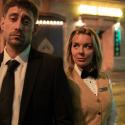
A year ago to the day the BBC laid on a festive slaughter of Agatha Christie characters. And Then There Were None had the look of a well-dressed abattoir as her victims toppled like ninepins at the hands of an invisible slayer. The scriptwriter Sarah Phelps has returned to the queen of crime for this year’s two-part Christmas murder mystery. The source for The Witness for the Prosecution is a mere 23-page story in which there’s really only house room for one corpse. It belongs to the unfortunate Emily French (Kim Cattrall), a hot-to-frot society dame of a certain vintage who has a weakness for the fresh bloom of youth.
One such, war veteran turned waiter Albert Vole (Billy Howle, pictured below with Cattrall), is lured home from a nightclub and paid to pleasure her. We’re not allowed to see quite why his technique is such a hit, but madame's green-eyed lady’s maid Miss Macintyre (Monica Dolan) gets an eyeful when she peaks through a crack in the boudoir door. It works because (unbeknown to Vole, or so he claims) the purring chatelaine has soon made him the sole beneficiary of her will. Not long after that, obviously, the maid discovered her mistress prone on the living room floor with her skull opened “like a tin of peaches”, and knew exactly who to blame.
 Step up, downtrodden jobbing solicitor Mayhew (Toby Jones), whose herculean task is to save Vole from the noose. His only hope is to persuade Vole’s paramour, a taciturn Austrian chorus girl called Romaine (Andrea Riseborough), to provide him with an alibi. By the end of the first hour, she had reneged on her original intention to save him, leaving us all to ponder the opacity of her motives. With the concluding episode still to come, we must consider the certainty that Riseborough isn’t here to make up the numbers, any more than Marlene Dietrich was when she played Romaine in Billy Wilder’s 1957 film nor Diana Rigg in the last TV adaptation in 1982. (No one’s been cast yet for Ben Affleck’s 2018 film. One for K Winslet?)
There isn’t a great deal of plot to get through in The Witness for the Prosecution, which has left Julian Jarrold (one of the directors of The Crown, also of the Fred West drama Appropriate Adult) plenty of scope to layer on the atmospherics. Grimy London of the 1920s comes up a treat in the dinginess of the police cells, the tawdry vaudeville theatre, above all in the awful digs where Mayhew and his wife live in a state of catatonic silence, munching on unappetising slop and mourning their son killed by a gas attack in the trenches. So dismal is the visual palette – all pock-marked brick and foggy pallor – you practically catch catarrh just watching.
 Phelps relishes the darker hues of this Christie story. There was much talk of hanging, dangling, ropes and nooses, and the gloss of politesse we are used to in Poirot and Miss Marple has been entirely ripped off as if by a corrosive paint stripper. Cattrall’s femme fatale said her “fires are supposed to be out but they rage unchecked”. Vole’s barrister (played by David Haig) concluded he “must be hung like a Clydesdale stallion” (Clydesdales being a cruiserweight breed of draught horse). We watched Jones (pictured) rutting like a desperate rabbit while his wife fretted about the bedsprings squealing like traitors. Meanwhile the cat lapped at the blood from her mistress’s murder weapon.
In this tasty adaptation it’s not all seething passions and grand guignol. Jarrold beautifully caught the orange stage lights flickering in Jones’s glasses: the home fires burning. Other subtle flavours are to be found in the performances of Jones and Riseborough. Somewhere under the surface of this intriguing top-to-bottom snapshot of post-Great War London is an angry rant about an entire society suffering from an incurable case of post-traumatic stress. There’s no solving that, detective.