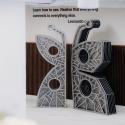
I’m a sucker for traditional vitrines and the procession of old style display cases installed by Ali Cherri in the Renaissance galleries of the Sainsbury Wing look very handsome.
During his residency at the National Gallery, the Lebanese artist has been researching evidence of trauma in the collection. Of course, images of torture, murder and cruelty abound in paintings of the humiliation and crucifixion of Christ and the many martyrdoms portrayed in gory detail for the edification of the faithful. It’s amazing how we can gaze with disinterested curiosity at open wounds, severed heads or suppurating sores and even consider their depiction beautiful.
Images of pain are not Cherri’s concern, though. Instead, he has been focusing on the violence committed against actual canvases. The most famous victim of assault must be Diego Velasquez’s Rokeby Venus,1646 which the suffragette Mary Richardson attacked with a meat clever in 1914. “I have tried to destroy the picture of the most beautiful woman in mythological history”, she explained afterwards, “as a protest against the Government for destroying Mrs. Pankhurst, who is the most beautiful character in modern history.”
Dubbing Richardson “Slasher Mary”, the press responded as if the assault had been carried out on a real woman, referring to one of the multiple cuts inflicted as “a cruel wound in the neck”. The painting has since been lovingly restored, of course, and little mention is made of the incident, partly to avoid encouraging copy-cat attacks and partly from a desire to allow the process of healing.
Cherri’s response to the event is interesting, but oblique. Reclining in a vitrine (pictured below) is the wooden carving of a female figure more akin to a prehistoric fertility goddess than a classical nude. Her bulbous body is covered in striations resembling scarification, but also recalling the lacerations inflicted on the painting. Its head – a 19th century marble carving – lies face-down on a mirror. Inset in one socket is a glass eye that peers accusingly at the viewer via the mirror, much as Velasquez’s Venus looks out of his picture via a mirror.
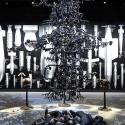
 If Cherri’s Venus feels disconcertingly helpless and vulnerable, his response to the violation of Rembrandt’s 1669 self-portrait (main picture), which was squirted with yellow paint in 1998, is even more extreme. A wax model of the artist’s severed head dangles from a chain like a trophy. Its dark colour and small size remind one of the shrunken heads sported by cannibals as proof of their military success.
Poussin’s The Adoration of the Golden Calf 1634 was similarly sprayed with paint in 2011. It shows worshipers dancing round a plinth on which stands a statue of the golden calf. Cherri has created a 3D plinth decorated with a classical frieze of dancing figures and replaced the calf with taxidermied twin lambs. A legendary object of pagan veneration has been replaced by actual Siamese twins that died from severe birth defects.
The artist’s most direct response is to the gunshot wound sustained in 1987 by Leonard’s Burlington House Cartoon 1500. By reproducing the bullet hole in low relief, he has transformed the wound into an insignia of martyrdom, a religious relic.
Cherri’s responses invite one to contemplate the degree to which artworks can be restored. Are they, like people, damaged permanently by trauma or are they venerated more highly once their frailty has been revealed? Is their value increased or diminished by the damage they have sustained?
- Ali Cherri: If you prick us, do we not bleed? at the National Gallery until 12 June
- More visual arts reviews on theartsdesk