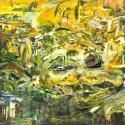
Flashes of intense colour pulse rhythmically across the piece, contrasting with delicate washes and pools of watery pigment that seem to quiver plumply, set to run uncontrollably at any moment. Lines drawn fast and bold describe four figures, while more tentative, carefully made marks barely delineate a foot, and a bird in a cage. If Chris Ofili’s new work, unveiled at the National Gallery on Tuesday, offers a glimpse into a dreamlike world of myth and magic, its execution represents nothing short of alchemy, the miraculous transformation of watercolour into tapestry.
Commissioned for the Clothworkers’ Hall in the City of London, where it will go on permanent display following this exhibition, the tapestry has endless resonances with the art of the past. Its evocations of classical mythology permit obvious comparisons with the Old Masters, amongst whom painters like Raphael and Goya produced designs for richly woven tapestries. Even the process of its creation is endearingly traditional: commissioned by the suitably ancient Clothworkers’ Company, Ofili produced a small watercolour for approval, a document akin to a contract design that served as the Dovecot Tapestry Studio’s main reference. From this, a cartoon was produced, allowing the basic design to be transferred to the weft threads, with a team of five craftsmen and women, usually working three at a time, setting to work with an undertaking of extraordinary and rare skill, on the final work that took some three years to complete.
 But while The Caged Bird’s Song is rooted in the art of the past, it is heavy with the artist’s own preoccupations, most bizarrely in the quasi-divine figure of a cocktail waiter in the sky, modelled on Italian footballer Mario Balotelli (pictured right: preparatory study). The title refers somewhat mysteriously to Maya Angelou’s autobiographical novel, and Ofili’s experiences of life in Trinidad are woven into the piece in its references to the colours, scenery and customs of the island. Two outer figures who seem to draw back the curtain on a mythical scene beyond are Trinidadian characters, a man with a caged bird opposite a woman holding the Crab Eye seeds that are said to make birds sing more sweetly.
The properties of watercolour are essential to the depiction of this watery Arcadia, and at the tapestry’s centre, where a man serenades a reclining woman, a pool meets the sea and a waterfall. Although Ofili stresses that the tapestry is an interpretation rather than a reproduction of his watercolour, its fidelity is awe-inspiring, capturing not just the freshness and vibrancy of the painting, but the idiosyncratic effects of liquid paint. Washes that meet and bleed into each other have retained in wool the complex and subtle effects of translucent layers of pigment, while areas of solid colour in the painting required three strands of yarn to be woven together to avoid a flat effect in the tapestry.
If the tapestry offers up a world of colour and storytelling, it is the monochrome depictions of temple dancers painted all around the Sunley Room that draw us in. In rendering our own world grey and flat, they pull us towards the light and colour of Ofili’s seductive scene, the unsettling prospect of Balotelli the cocktail waiter’s strange elixir, and the thunderstorm in the distance the only intimation that trouble might be brewing in Paradise.
- Chris Ofili: Weaving Magic at the National Gallery to 28 August
- Read more visual arts reviews on theartsdesk