When he was a callow youth of 18, German artist Anselm Keifer got a travel grant to follow in the footsteps of his idol, Vincent van Gogh. Some sixty years later, work by the two artists has been brought together at the Royal Academy in a show that highlights Van Gogh’s influence on his acolyte and invites you to compare and contrast.
In the intervening years, Keifer has gained a huge international reputation with gargantuan paintings, sculptures and installations. His obsession with Van Gogh led him, in 1992, to move to the south of France where he transformed a former silk factory and the surrounding 40 hectare estate into a vast art installation. He is like the Wagner of visual arts – nearly everything is on a vast scale. And people tend to love or loathe the scope of his ambition, seeing it as either deeply meaningful or pretentiously overblown. This show may well flip you from one camp to the other.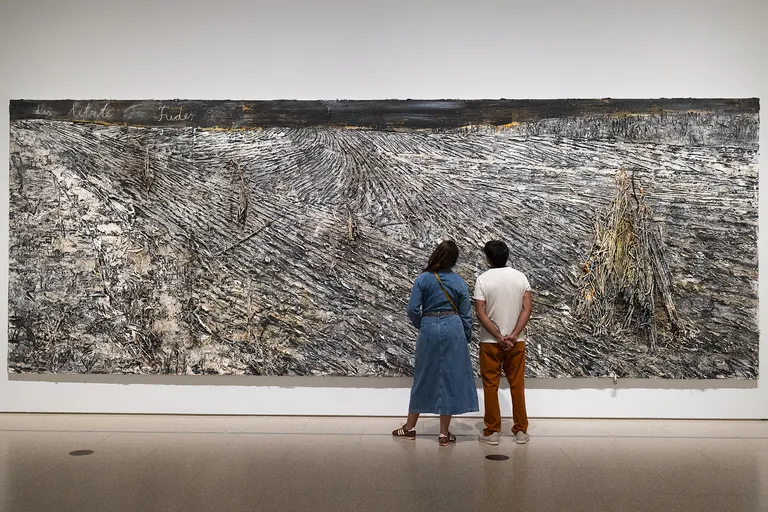 Keifer tries to match Van Gogh’s level of intensity by upping the ante. Take his version of Van Gogh’s The Starry Night, 1889, for example (main picture). Glued onto an enormous canvas, swathes of straw are wound into an eye-shaped swirl that imitates the cosmic turbulence of the original. Straw blobs stand in for stars and, perhaps aware that straw does not readily conjure the radiance of starlight or evoke a heightened sense of ecstasy, Keifer adds some gold leaf to the mix. Whereas van Gogh evokes a world made unstable by ecstatic inner turmoil, Keifer’s remix is about as poetic as a cow pat flung into the sky.
Earthiness can sometimes be a strength, though. In the same gallery hangs The Last Load (Das letzte Fuder), 2019 (pictured above). A loan sheaf of corn stands sentinel over dark furrows devoid of any trace of life. The sky is black and the horizon line is so high it feels as if your nose is pressed into the lifeless soil. It’s a scene of devastation and, because Kiefer allows space for one’s own interpretation, it is also very moving.
Named after the Greek gods of love and death, Eros and Thanatos, 2013-19, addresses the twin forces that govern existence. This time, though, Kiefer hammers home the message by attaching the kind of scythe once used by farmers for harvesting grain and by the Grim Reaper for gleaning souls to an expanse of empty furrows gleaming only with gold leaf. And the result is dreadful kitsch.
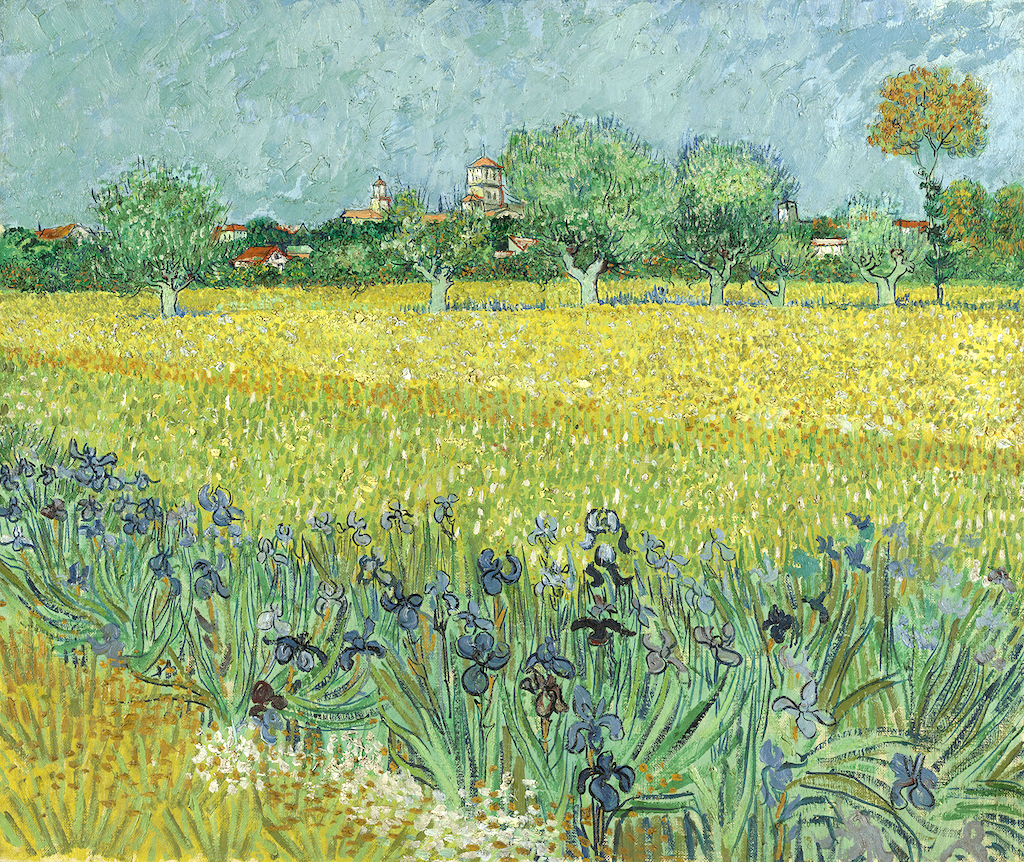 Comparing this banal concoction with Van Gogh’s joyous painting of a field of corn fringed with irises (pictured right) brings home the fact that whereas Van Gogh uses vibrant colour to celebrate life, Kiefer's ashen grey paintings reveal an obsession with death. The artists are like chalk and cheese; Van Gogh’s pictures are an outpouring of passion and their immediacy is palpable; Keifer, on the other hand, relies on drama to fill an aching void of melancholy that no amount of gold leaf can disguise.