There was something perverse about the opening of Liza Lou’s show at White Cube in Hoxton Square on a wet Thursday evening. It was as quiet as I’ve ever known it inside, while outside, barred from drinking among Lou’s fragile works, a throng of people guzzled free beer on the other side of the street in the rain.
From the second floor where the most plaintive works shimmer against the white walls, you could look down and wonder why White Cube insists on plying them with beer. It seems to add the same kind of crowd-fuelled bluster to the event as movie premieres, to make the invited feel special. The contrast seemed apt, however, because the White Cube is hosting largely shy works that whisper, that demand an intimate peace when you stand close before them. The show entirely comprises mixed-sized “paintings” supporting sheets of varying sized beads delicately stitched together.
It’s the accidents and imperfections that structure your experience at closer inspection
Lou has carved a niche from her favoured medium: she once produced a life-scale kitchen in beads, and a bead backyard with a beaded lawnmower shaving a lawn in which every blade of grass was a string of beads. Both painstaking projects (which are said to have given Lou tendonitis) have the same cranky devotion to craft as some of the most extreme forms of outsider art, as thrilling and repulsive as scar tissue. Both are lurid with the obsession invested in them matched by the warped proximity to the forms and colours of their subject matter.
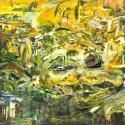
 In contrast, despite the same medium, the work here is plaintive and largely quiet. We have collector-friendly canvases supporting mostly monochrome or almost-monochrome sheets of beads in ivory, blue and gold. There are patchworks of modulating tones and colours of beads stained in the working process. Though none are particularly large, these are monuments in terms of the time invested in them.
A smaller canvas, Zulu Love Letter No.2, is the only work with a title as such and it helpfully aligns all the “paintings” to bead work in Zulu culture which plays an important and symbolic role in courtship. The small monochrome is exquisite, its lines of tiny gold beads are cleaved apart to yield to the frays of the cut threads that held them together. These cuts have a heightened violence to them like a plant uprooted to reveal its underside.

Some beaded sheets and nets hang off simple wooden frames, and these are the least interesting. For one thing, riffing on the support has already been done to death and these works would seem like a student’s conceit if it weren't for the extreme delicacy of the fabrication. They are also manage to push the viewer back with their emphasis on shape. It’s the subtlety of the larger mono- and duochromes that seduce, that invite close inspection. They sparkle gently under the light as you approach, get intimate with the surface and find yourself immersed in the labour invested in these sheets.
Beads denote rhythm, they serve to quantify and count, and Lou fetishises the rhythm of labour as a negation of living. Every threaded bead could be a moment doing something else and you can’t help but ponder on her assistants’ time cruelly divested. It’s the accidents and imperfections that structure your experience at closer inspection: the loose threads, ruptures, pocks and dimples, and it’s here, up close, to our relief, that we find the life in these works. This is particularly the case for the ivory and cream works upstairs. Five conventionally shaped paintings titled Canvas (#4,#8,#9,#5,#6), see through the success of this method, and, dare I say it, there’s something of Rothko’s Seagram Mural about these works, together so quiet and exhilarating.
In Lou’s unique way of working we find a synthesis of the miniature and monumental, an artistic feat. But the works show mixed success with some misplaced interactions with the supports and works that feel like mere variations of Lou’s method. It’s the refined and quieter works which, in their simplicity, distil time and experience so potently.
- Liza Lou at White Cube Hoxton until 26 May