How can you review LS Lowry? The Salford rent-collector-cum-painter simply did what he did: sending his bendy, pipe-cleaner people through white-floored industrial streets, in scenes that seemed hardly to change in decades. While Lowry fully qualifies for that currently fashionable status "outsider artist", there’s nothing remotely edgy about him. He’s as cuddly and quintessentially English as Thora Hird. Anyone likely to have an opinion on him will long since have formed it. Everyone else will simply be indifferent.
While the Cornish primitive Alfred Wallis, with whom Lowry has obvious parallels, is more popular than ever – probably recognised generally now as "truer" in his vision than his St Ives patrons Ben Nicholson and Barbara Hepworth – Lowry has yet to be recuperated by contemporary art. Despite the building of the Lowry Centre in Salford to house his works, his popularity feels beleaguered in the dingy mid-20th century, the province of a substantial, but demographically diminishing middle-brow audience.
Yet Lowry is, as this fair-sized exhibition makes apparent, a more complex artist than Wallis, more problematic in his mixing of the naive and the sophisticated, and therefore potentially far more interesting. At the centre of the display of 38 works mostly from the 1950s and Sixties is the enigma of Lowry’s identity as an artist: whether he was an Aspergic eccentric essentially repainting the same work for decades; a whimsical illustrator who was having everybody on; or a secret formalist exploring a rarefied personal language of a plane, space and stringently limited colour palette.
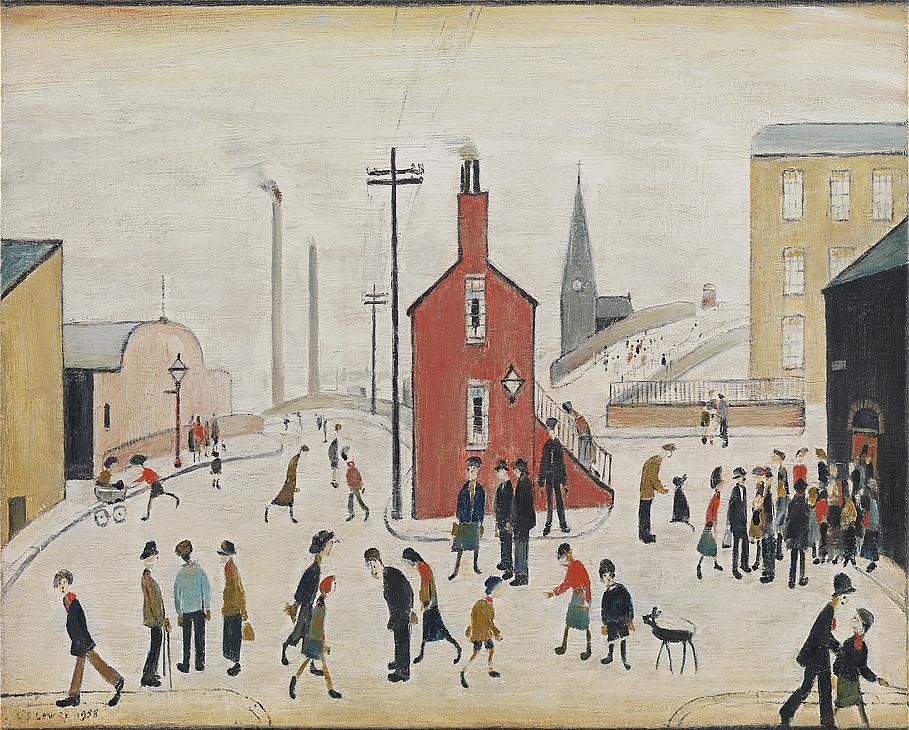 Lowry’s vision was in many respects architectural. Old Road Falsworth is defined by a receding curve of pink-faced, smoke-belching industrial cottages, On a Crowded Station Platform, Paddington by horizontal bands of railway lines and arched windows. A gable-ended house bang in the middle of Street Scene, 1957 (pictured above), locks together the ochre-tinged white sky and the ochre-tinged white street passing either side of it – a device that appears in another Street Scene of 1958 and an exquisite drawing of 1953.
The block-like industrial buildings in Going to Work, all in heavily muted vermilion and Prussian blue, recede in a subtly differentiated persepective worthy of Piero della Francesca, while the effect of primary-coloured planes against white, seen here and in large numbers of Lowry’s paintings, is weirdly reminiscent of Malevitch’s Suprematist works.
Against all this precisely perceived structure, Lowry’s figures tend to be smudgily formless and painfully illustrative. Seen in small groups of enlarged figures on white from the 1960s, they come close to the kind of mawkish park-railing tat seen in the cheaper trattorias of the time. Yet when Lowry gets his people moving en masse, to the factory or away from the football, as in After the Match, the sense of collective purpose is deeply felt – though he can’t resist turning their massed vertical forms into yet another geometric plane.
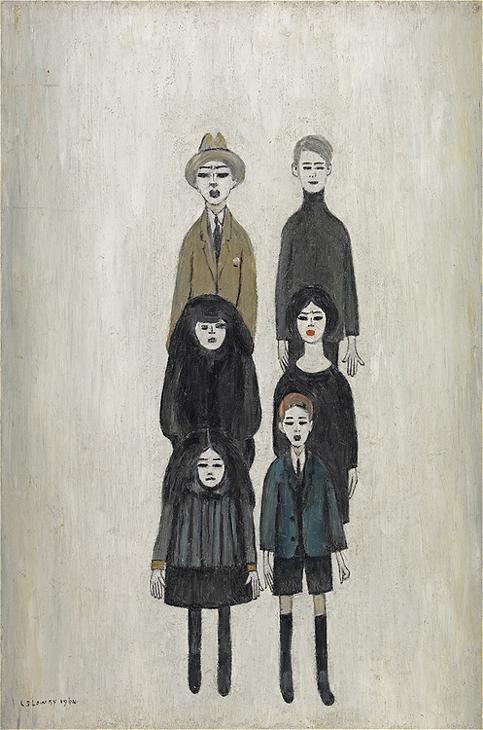 While we think of Lowry’s figures as marooned in the smoky 1930s, the girls in Family Group at the Seaside, with their long hair and jeans – one with fag in mouth – belong very convincingly to the 1960s. And some of those painted figure groups do achieve a stark intensity. In A Family of Six, 1964 (pictured left), inspired, we are told, by Pirandello’s Six Characters in Search of an Author, the figures are seen in an uptilted perspective that appears again in some of his more unusual streetscapes, such as The Old Terrace Steps, Maryport, where the flattened space creates a powerful T-shape from the steps and upper terrace against grey-green grass.
Finally, the thickly impasted grey-on-white seascapes face the eternal, though the most valedictory of them, the dreamlike The Floating Bridge, Southampton, is one of the earlier paintings here. There’s a touch of genius in the severely symmetrical composition, with the far shore breaking up into a nicotined white haze; though it's difficult to be sure whether the elongated figures striding towards us off the ferry enhance this impression or entirely destroy it.
Aspergic eccentric, whimsical illustrator or secret formalist? Lowry was a bit of all of these, which makes him all the more difficult for current taste to accommodate and all the more ripe for a major reassessment.
- LS Lowry is at the Richard Green Gallery, 33 Bond Street, London W1S 2RS until 17 December