Manga, the Japanese art of the graphic novel, took its modern form in the 1800s. Illustrated stories already had a long heritage in Japan — encompassing woodblock prints and illustrated scrolls and novels — but the introduction of the printing press by foreign visitors changed the rate at which works could be made and the extent of their distribution.
 Part of manga’s appeal is its restlessness — it never gets stale. While the 1950s saw distinctions crystallise between shōnen and seinen manga (respectively for boys and young men) and shōjo manga (for girls), the 70s saw the Year 24 Group of female manga artists break down formal and narrative boundaries, broaching taboo subjects around sexuality and gender and seeking fresh ways of expressing narrative graphically. Today it is big business, with revenue in 2016 reaching around $3 billion — curious for an art form which prioritises the stories of outsiders.
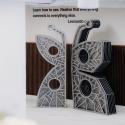
The British Museum’s impressive exhibition opens by explaining the meanings behind manga symbols (pitcured right), how to read manga (from right to left, downwards), and offering a glimpse into the workings of the four main manga production houses — the late nights artists work, the importance of artist-editor relationships and the even itemising the tools of the trade. Later parts unfold an array of specialised genres that have developed in recent decades — such as BL, or Boy Love, which focuses on male homosexual romantic relationships and caters primarily for a female audience — and introduce iconic manga artists, such as Inoue Takehiko, whose popular serial REAL followed the lives of teenage wheelchair basketball players, and Takemiya Keiko's gorgeous sci-fi epic Towards the Terra which follows two soldiers’ attempt to stop a futuristic supercomputer wiping out a race of preternaturally-gifted humans.
 The show is equally strong on manga’s heterogeneous inspirations, both Japanese and foreign. Sugiura Hinako's Sarusuberi — which tells the story of Hokusai's artist daughter Oei — hangs next to Hokusai's depiction of the ghost of Koheiji, come back to haunt his murderous wife and her lover. Kawanabe Kyōsai's Ink Battle captures a sense of anarchic detail also seen in Kobayashi Kiyochika's newspaper manga Machine for Rotating Eyes; Tezuka Osamu's New Treasure Island hangs next to posters for Disney’s Donald Duck and Micky Mouse. Other highlights include Hagio Moto's The Poe Clan which follows a group of vampires and is as formally innovative as it is ravishing and Akatsuka Fujio's charmingly anti-establishment The End of Unangi-inu, in which Eel-dog laughs himself to death at a policeman’s comment.
It's a dense exhibition that, because of the time demanded by each piece on display, can feel overwhelming. Information cards are low down and lighting can be spotty, but imaginative touches like ceiling banners and patterned lighting combine in an intimate, immersive experience that culminates in a central reconstruction of a manga bookstore. Here you can browse and hold the manga in your hands — engage with it physically and narratively, as intended. And with such a wealth of material on show, there’s a story for everyone.
- Manga is at the British Museum until 26 August 2019
- Read more visual arts on theartsdesk