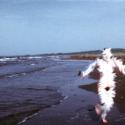
It’s been a turbulent week for British artist Kate Daudy. Am I My Brother’s Keeper, her refugee tent (main picture), the art installation and seminal work that propelled her to international fame is gone, thrown out with the trash.
"A nun destroyed the tent," Daudy explains. The work, a UNHCR tent embroidered with words and pictures, was being stored at a convent in Spain where it was unintentionally thrown into a skip. It’s a big loss.
Working on the project, meeting Syrian refugees in Jordan and hearing their stories, Daudy says, changed her life. The refugees’ own words adorned the white canvas highlighting their dignity and hope.
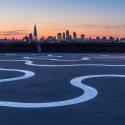
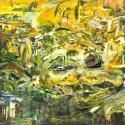
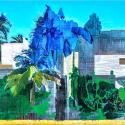
 Sitting in her north London studio as tube trains clatter past, Daudy says she will make another tent. But now her priority is finalising an NFT (Non-Fungible Token), Everything Is Connected (pictured right), which goes live as part of Invisible Ether, an online exhibition dedicated to NFTs hosted by The Hermitage Museum, St Petersburg.
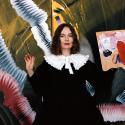
Daudy (pictured below left) explains the work is a generative NFT using random and selective means of creating colourful trees. The trees appear in different colours or shapes depending on the coding rules. It’s the artist’s first foray into NFTs.
‘’For me to a be able to express myself in a way that can be made manifest through another language, through another medium, by somebody else is really interesting and makes me think about human communication and how we interreact and the endless layers of miscommunication and misunderstanding,’’ Daudy says.
A third of the profits from Everything is Connected will go to the Malala Fund, the girls’ education charity founded by Malala Yousafzai.
The NFT is a collaboration with the Nobel prize-winning physicist Kostya Novoselov. The Russian-born scientist was awarded the Nobel Prize in 2010 for his work on graphene – a wonder substance that is both strong and the thinnest known material.
The artist and scientist have had a long collaboration, most recently at the Yorkshire Sculpture Park in September. Here their show Wonderchaos explored the many facets of chaos: in nature, mathematics, history, and everyday randomness. It was a fitting show for chaotic times: pandemic, global warming, supply chain disruption, discrimination.
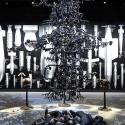
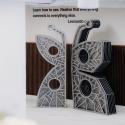
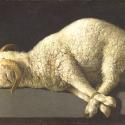
 Wonderchaos was a challenging, intense but ultimately joyful show that urged visitors to be unafraid of chaos, to find beauty in the unexpected. Sheep roamed the park with numbers sprayed on their wool so as they grouped around each other random numbers were generated. The show, like Daudy’s now destroyed tent, raised fundamental questions about how we live our lives and urged visitors to look for inherent human connections.
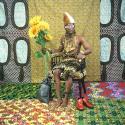
It was a deep dive into the subject much as Daudy did in 2019 at the Saatchi Gallery in her modern interpretation of the global blockbuster Tutankhamen: Treasures of the Golden Pharaoh.
Daudy is effortlessly positive and her work reflects that; it’s whimsical and full of fun and joy. But the cheerful façade belies a beefy intellect and unique insights. She draws inspiration from Chinese calligraphy and hopes her works will be tools for listening.
"People like to make a correlation between being cynical and dark about things and being intelligent I think that’s a mistake. Just because you see bad everywhere It doesn’t make you more intelligent," she says. The artist says that working with refugees uprooted any cynicism she might have harboured.
"When you knock off all the crap on the top of people…all the worries and the insecurity and everything is gone, there is generosity, dignity, courage, sweetness of disposition, all of these extraordinary qualities that I saw when I met these refugees."
This autumn is a watershed for Daudy as the last of her three children has left home, leaving her with more time for her art and its message of a shared humanity and hope.