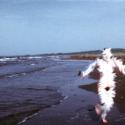
Anyone lucky enough to have a garden will be newly appreciative of the oasis that even the humblest of outdoor spaces can provide. Based on the Royal Academy’s hugely successful 2016 exhibition of the same name, and broadcast on Monday evening by Exhibition on Screen via Facebook, Painting the Modern Garden opened the door to a different world. As the camera lingered on constellations of dahlias, banks of lavender and waterlilies, tended by contented insects to the twitter of birdsong, the film’s opening sequences plunged us into the living artwork that is Monet’s (not humble) garden at Giverny (main picture).
Monet, the painter of water-lilies, might be the most famous of artist-gardeners, but he is one of many who found in his garden not just an ever-ready, ever-changing subject to return to again and again, but a place to experiment and to refresh body and mind. Their tranquility might seem at odds with the frenetic, urban preoccupations of the avant-garde, but gardens were a vital component in the modernist projects of the late 19th and early 20th centuries.
 For Kandinsky, Matisse, and Nolde, gardens were living palettes, allowing them limitless scope to experiment with pure colour. The German impressionist Max Liebermann created a series of gardens, providing himself with a variety of subjects to paint, while Joaquín Sorolla’s Islamic-inspired gardens were popular with his American clientele. For Monet, painting and gardening were perhaps uniquely entwined, the head gardener at Giverny speaking with insight about the connection between the planting at Giverny and Monet’s canvases. Monet’s garden became, over time, a work of art in itself, the forerunner of Robert Smithson’s land art.
Gardening was a pastime that emerged with the middle-classes in the 19th century, against the backdrop of the new science of horticulture, and the discovery of exotic species across the globe. In the wake of Darwin’s On the Origin of Species, published to much controversy in 1859, Monet and Caillebotte’s shared trips to flower shows seem more subversive than quaint, the cultivation of plant varieties a conspicuous intervention in the natural world (pictured above: Monet, The Artist's Garden in Argenteuil, 1873).
Gardens have been depicted in painting since ancient times, accumulating symbolic resonances over the centuries as expressions of the Virgin Mary’s purity, or of pure power at Versailles in the 17th century. Munch didn’t just paint an apple tree, but each time explored afresh the Garden of Eden, and the Tree of Good and Evil.
Made within the sound of the western front, Monet’s immersive expanses of waterlilies generated new resonances, with the artist giving a vast panorama to the French state following the Armistice in 1918. Increasingly abstract, Monet located the universal in the smallest detail, finding within a ripple on the pond not just respite, but the painterly impulses that would blossom anew in the mid-20th century.