On the evidence of this Serpentine exhibition of huge sculptures, small sculptures, photographs, drawings, watercolours and prints, the German artist Thomas Schütte is obsessed, but obsessed, with faces. It is billed as the first show to focus entirely on his portraiture, of himself, his friends, and from the imagination. And the focus helps the visitor to grasp how playfully serious – or seriously playful – the artist is.
He shows us he can do any idiom in various media. He can distort representation making faces almost unbearably malleable. Are these people menacing, sneering, contemptuous, frightened, or fearful? And then here are lots of relatively straightforward drawings, almost touchingly the kind any good amateur could put forward, seemingly inhabitants of an unthreatening middle-class milieu.
 This concise anthology acts as a subtext to his immensely productive outpourings, gently satirical as in his architectural Ikea houses, his temples and meditations on museums, and his installations of ceramic urns entitled Is there Life Before Death? So there Damien Hirst: Schütte’s elusive poetic titles are succinct and thought-provoking, with one series of semi-imaginary portrait heads is simply called Dirty Dictators. This spacious show is not only resonant in its own right, but acts as a helpful introduction to a highly educated imagination that never strays from the human, from the artifacts people surround themselves with to the human beast itself.
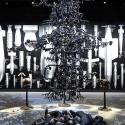
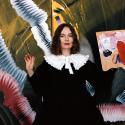
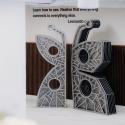
Outside the gallery there are two huge patinated bronze sculptures, each like adult Siamese twins, the bodies swaddled, with no apparent limbs, supported by a tripod. From these over life-size statues two rather caricatured heads emerge at oblique angles to each other. United Enemies is the explanatory titles. So we are a little discombobulated before rather disarmingly inside the Serpentine we start with an early self portrait, of 1975 (pictured above right; © 2012 Gautier Deblonde) the artist as a rather romantic creature, dishevelled hair, open-neck shirt, dark glasses, perhaps in recovery mode from the night before: art student idiom.
Schütte spent some seven years at the Dusseldorf art academy, the seeding ground for the dominant avant garde of Europe, and where he was taught by Gerhard Richter, amongst other eminent artists. He still lives in Dusseldorf, which, in the 1970s, was actually described in a municipal directory as the City of Artists.
 Gently mocking yet curiously powerful, the self-portrait faces 2011 Memorial for unknown artist (pictured left; © 2012 Gautier Deblonde) in which a bearded guru, arms upraised in salute or supplication, emerges from a coppery coloured steel cylinder. The 2010 steel sculpture, Father State, is perhaps even more explicit, a dignified berobed and becapped leader, but of course we do not know whether he is a hero or a dictator, or a hero-turned-dictator. The piece could be a cliché or a parody or a straightforward piece of subtle admiration of someone who is genuinely virtuous – or who has got away with it.
A room full of patinated bronze heads on steel shelves mocks those neoclassical interiors where contemporary worthies, or sages from the past, divine or otherwise, are ranged in procession to look down on the mortals below. Entitled Jerks, they appear like parodied figures of authority. Innocenti is a series of photographs of whitish heads, their features pushed every which way, but their hollowed-out eyes the conventional outlines of classical sculpture. The most elaborate faces look as though they are made of silly putty, or melting wax, their facial features either on the point of dissolution or of hardening (Medardo Rosso, the underated Italian symbolist comes to mind). Sometimes they remind the spectator of faces which have suffered horrific burns or assaults of other kinds.
The mood is always ambivalent, ambiguous, changeable and unpredictable. Instability is always implicit. We are disarmed because we recognise what is being shown, yet also made uneasy, startled and surprised. We leave wondering what kind of face we ourselves inhabit, all too aware of the enigma of appearance and its metamorphoses – and the inescapable imminence of decay.
- Thomas Schütte: Faces and Figures at the Serpentine Gallery until 18 November