

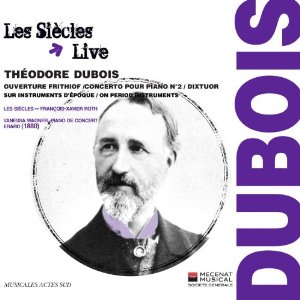
François-Xavier Roth’s period band have already given us invigorating takes on Stravinsky and Saint-Saëns, and now turn to the music of Théodore Dubois (1837-1924). Barely known outside France, Dubois was known as an organist and as director of the Paris Conservatoire at the turn of the century. The weightiest work here is the Piano Concerto no 2. Immediately engaging, this is a fun listen – though you’re constantly reminded of concertos by other composers with stronger profiles. Nothing outstays its welcome – a brief, rapturous slow movement and a witty, ephemeral scherzando whoosh past in barely seven minutes. Soloist Vanessa Wagner plays an 1874 Érard - the lighter, clearer sound perfectly foiled by Les Siècles; the concerto’s manic, chattering close sounding so, so French. Delicious.
Yet more distinctive is the Dixtuor scored for wind and string quintets. Dubois’s wind writing is always idiomatic; there’s a lovely passage for horn and clarinet at the start of the Larghetto, and the whole work just feels ‘right’ , with period instruments lending gossamer lightness to the faster music. The disc opens with the Ouverture de Frithiof, ten minutes of entertaining, slightly anonymous melodramatic fluff. Excellent performances which leave you curious to hear more by Dubois.

Writing about contemporary music in a lucid manner is like juggling cats. You read a statement in the booklet like “the idea behind system/error is the contradiction between the theoretical precision and control of formalised compositional systems and the practical imprecision and accidents associated with the sonic realities of performance and interpretation of notations” and your first instinct is to run away. It's hard work, in other words. But take a deep breath and concentrate, and you’ll find that system/error is a blast. Sam Hayden has a brilliant ear – the overlapping violin, flute and percussion lines deliciously collide and converse. You’re left reeling at the fact that these rich sounds can be produced by so few players and can actually be notated.
In terms of sonority, Hayden’s misguided is a triumph – 20 minutes of rasping, reedy blasts from brass and winds, the apparent randomness of the outbursts uniquely unsettling. Like eavesdropping on players warming up individually in a green room and suddenly making eye contact. The larger scale Die Modularitäten feels still more accessible, the range of gestures more familiar, though the ghostly electronic interruptions chill the blood. NMC didn’t have room for Hayden’s schismatics on the disc, so you can get it as a free download on their website. Mieko Kanno’s electric violin duets with Hayden’s live electronics, the two voices feeding off each other. The artificial sounds are mesmerising, transforming a two-person chamber piece into something larger and less tangible. All stimulating, and Virgil Ferragut’s sleeve art is equally imposing.
Watch Sam Haydn talk about presence/absence

Liszt’s Totentanz invites the listener to grin as hard as it tries to terrify, coming from a composer whose death obsession led him to make a habit of visiting the cells of prisoners awaiting execution. These variations for piano and orchestra on the Dies Irae unfold with a cheeky inventiveness which is never quite squashed by the score’s blacker moments; if Totentanz was a person it would sport a waxed moustache and wear a black cape. Within seconds you can hear how it influenced the likes of Rachmaninov and Bartók. Andrea Kauten’s fearless physicality in the louder solo passages is fabulous. She’s also marvellous in the Malédiction, an extended single movement far less sinister than the title might suggest. I’ve never been made so aware of the crucial orchestral percussion in Liszt’s Hungarian Fantasy as I have in this performance; Ádám Medveczky’s Savaria Symphony Orchestra offer vibrant support throughout. They also give us an imposing Les Préludes.
The pounding fifths at the start of the first Mephisto Waltz retain their shock value. Kauten’s accounts of the pieces making up the Italian-themed second year of Années de Pèlerinage are unusually bold and commanding. The three Petrarch Sonnets show her dreamier, more reflective side and the set ends with an emphatic, enjoyable assault on Liszt’s Hungarian Rhapsody no 14. A comprehensive Liszt greatest hits compilation, beautifully produced and well-annotated.











