For last year's Europe Day concert, presidency-holder Spain fielded a Paco Peña showstopper in what's for the past three years been the venue of choice, St John's, Smith Square. This 9 May, the Hungarians' six-month stint yielded not a wow-factor spectacular - for me, that would have been a knees-up with violinist Gaby Lakatos - but instead a worthy and far from dull celebration of the Liszt bicentenary with 13-year-old Ferenc/Franz's one-act opera, Don Sanche.
Only sizeable chunks of it, actually, because the nature of the event is a concise, hour-long celebration. Yet if the work itself shows incredible facility for a teenager rather than any obvious genius, no one could have thrown more youthful zest and tonal lustre at it than four singers from the European Opera Centre and a sizeable European Union Youth Orchestra under Laurent Pillot. All of them, by the way, gave their services for the greater glory of Europe.
You'd be hard pressed to work out the enchanted-castle plot of Don Sanche, and the choice of excerpts not in the original order might have foxed anyone with head down in the synopsis. What impressed about the piece, written for Paris's Academy of Music and premiered in 1825 with the title role sung by the distinguished tenor Adolphe Nourrit, who picked up the diminutive prodigy-composer during the rapturous applause, were two things: the surprising fluency of the orchestral music between several vocal set pieces, which may or may not have been completed by Liszt's teacher, Ferdinando Paer, and the fleeting moments of genuine childlike exuberance.
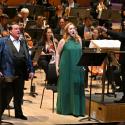
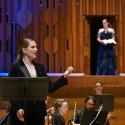
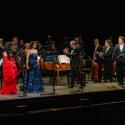
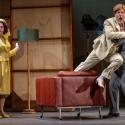
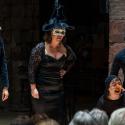
 Performance-wise, it introduced us to two impressive mezzos from the Liverpool-based EOC: Ingeborg Gillebo (pictured second from left in the blue), a Norwegian of beguiling stage presence, and Anaïk Morel, matching a well-modulated, larger voice to the best French (not surprising; she hails from Lyon). There was a useful, loud, stand-and-deliver Sicilian tenor, Giulio Pelligra, and a fledgling bass baritone, Shadi Torbey (pictured far left). The musical highlight, though, was the naive little march-intermezzo based on the tenor's merry aria "Aimer, aimer", delivered with deservedly emphatic zest by Pillot and the EUYO. This, if anything, is the encore conductors could pre-announce at any future Liszt celebrations ("Listen to what a clever little chap he was at 13!") and alone deserves to be pickled in the cabinet of composers' youthful curiosities. The grown-up Liszt, incidentally, wanted his youthful all-too-discreet exercise dead and buried; but the score was rediscovered in the Palais Garnier library in 1903 and the present edition is the result of painstaking work by musicologist Gerhard Krammer.
Well-tempered preliminary speeches by the respective heads of the UK's European Commission Representation and European Parliament Information Office, as well as the Hungarian Ambassador, kept everybody jolly yesterday evening: we may have heard, said Michael Shackleton, that European flags were not being flown in certain quarters, but we could at least be cheerful at the flag display in Parliament Square, courtesy of Westminster Council. The EC's intensive cultural programme in London also underpins tomorrow's European Literature Night III at the British Library, chaired as before by Rosie Goldsmith.
Did I say "Europe" and "European" enough? Well, put it this way: I was happy to stand for the strains of Beethoven's Ode to Joy as taken by the EUYO last night from the orchestral portion of the Ninth Symphony's finale.
- Further details of European Literature Night III
- Find out more about the events of Liszt 2011
- Details of the European Union Youth Orchestra's summer tour
Listen to the tenor aria "Aimer, aimer"