Schubert’s winter wanderer had Wilhelm Muller to voice his despair, while Schumann’s poet-in-love had Heinrich Heine. The lovers of Hugo Wolf’s Italienisches Liederbuch must make do with only the words of anonymous Italian authors, albeit dressed up for the salon in elegant German translations by Paul Heyse. The difference is telling, and for all Wolf’s harmonic ingenuity, his cruel, clever wit and the giddy emotional range we traverse in these 46 musical miniatures, they remain fragments – a glittering, tessellated sequence that conceals little behind its shining surface.
In some ways it’s not a fair fight. The Liederbuch is precisely that: a songbook rather than a cycle. Each song (few lasting more than two minutes) brings with it a new narrator, creating a bewildering collage of characters and romantic scenarios. But the temptation has always been to turn monologues into dialogues, to string the songs together into dramatic encounters shared between a soprano and baritone – the male and female speakers of the verses.
Close your eyes and this was bliss
Here however we had a tenor and soprano in Jonas Kaufmann and Diana Damrau – a pair of lovers whose collective star-power rather pulled against the scrappy, brittle, youthful quality of so many of the songs. Many musical paths can lead between contemplative opener “Auch kleine Dinge”, tiny and glowing as the pearls it describes, and the defiant sass of “Ich hab’ in Penna” that closes the set; the singers chose one that took us from capricious, flirtatious youth, through mature love and the suffering of separation and war, to mature sexuality and desire.
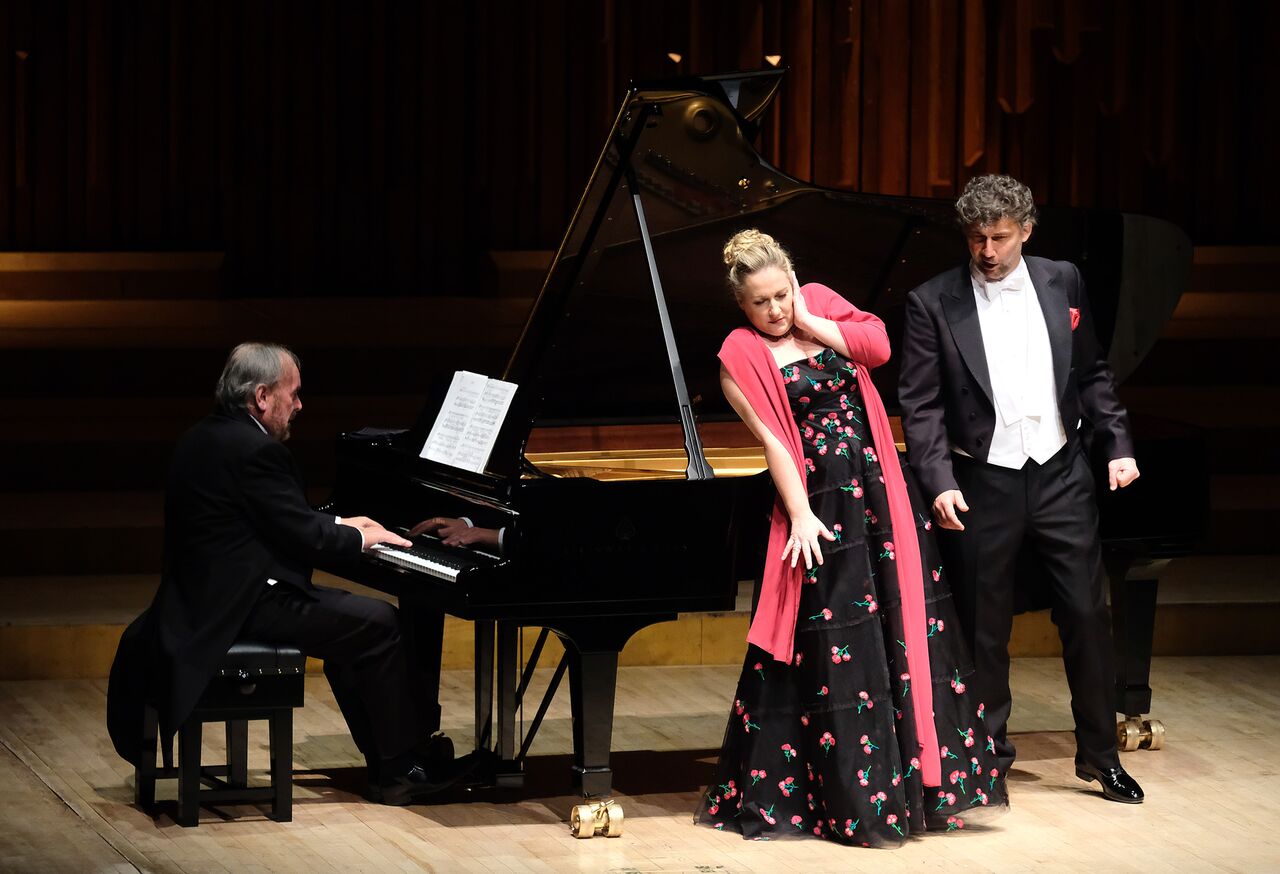 Without a director’s hand to steady things, the physical by-play of the framing sections was shamelessly overworked. Damrau especially, whose female speakers tended often to the petulant, ringlet-tossing end of the spectrum, grimaced and mimed gamely, underlining comedy whose deft musical punchlines needed no help from her dramatic red pen. Kaufmann – a straight man trying to play the clown – gave us broad slapstick where we should have had irony, insinuation, rueful mischief.
But close your eyes and this was bliss. Damrau’s silver-spun tone crept into the tiniest nooks of nuance and expression in these small songs, now thickly veiled (“Mein Liebster singt am Haus”), now stiletto-sharp (“Schweig’ einmal still”), now exquisitely vulgar (“Nein, junger Herr”), now blanched into fragile purity (“Wir haben beide lange Zeit geschwiegen”). If Kaufmann lacked the textural range of a Gerhaher, his tenor lovers had an airy openness to them, and the whole performance had an ease to it we rarely hear from him in the opera house, letting text not tone dominate. His “Sterb’ ich, so hullt in Blumen meine Glieder” was a single exhalation of the simplest, most devastating kind.
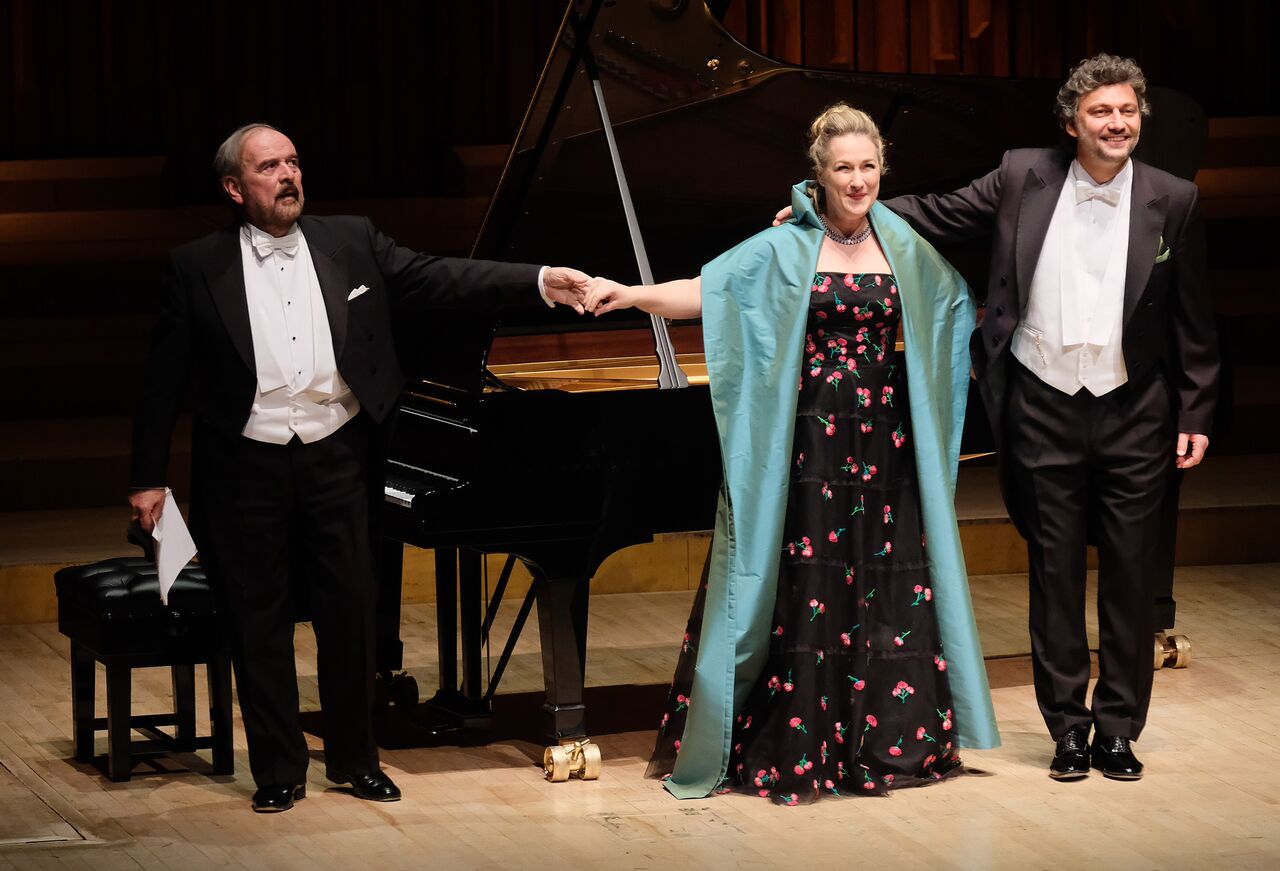 But the constant through all the vicissitudes of love, the kissing and bickering, the breaking-up and making-up, were Helmut Deutsch’s accompaniments. A magician couldn’t have conjured a downier, softer musical feather-bed beneath the voices, nor placed every narrative note of Wolf’s accompaniment with such instinctive timing. Straight-faced through it all – understated as a Savile Row suit at a fancy dress party – it was he who startled the only moment of true comedy out of the evening. One of the finest song-pianists alive playing the role of a truly, cripplingly, horrifyingly terrible violinist: now that’s a punchline worth waiting for.