

From a privileged position in the Festival Hall stalls, I could see 97-year old Herbert Blomstedt’s near-immobile back as he sat on a piano stool with the score in front of him, but also his supremely expressive right arm and hand, every finger brought into play, the left hand occasionally visible to me as he raised it at moments of high emotion. The Philharmonia simply burned for him, every phrase and dynamic brought into focus to heighten an already assured vision.
Only absolute mastery will do for Mahler's Ninth, his deepest symphony, its first movement alone a monumental test of ebb and flow, peaks collapsing into troughs, sloughs of despond raising themselves to carry out the song of the fragile beauty of existence. It would be harder to find more articulate string playing; oh, to have been there at the rehearsals when questions of articulation must have been discussed. At the front desk of the first violins, that supreme and humane leader Zsolt-Tihamér Visontay (pictured below guiding Blomstedt back for further applause at the end) and Rebecca Chan offered clear physical guidance, while at the other end of the phenomenal sound-spectrum, Tim Gibbs cast keen glances at his seven fellow double-bassists. 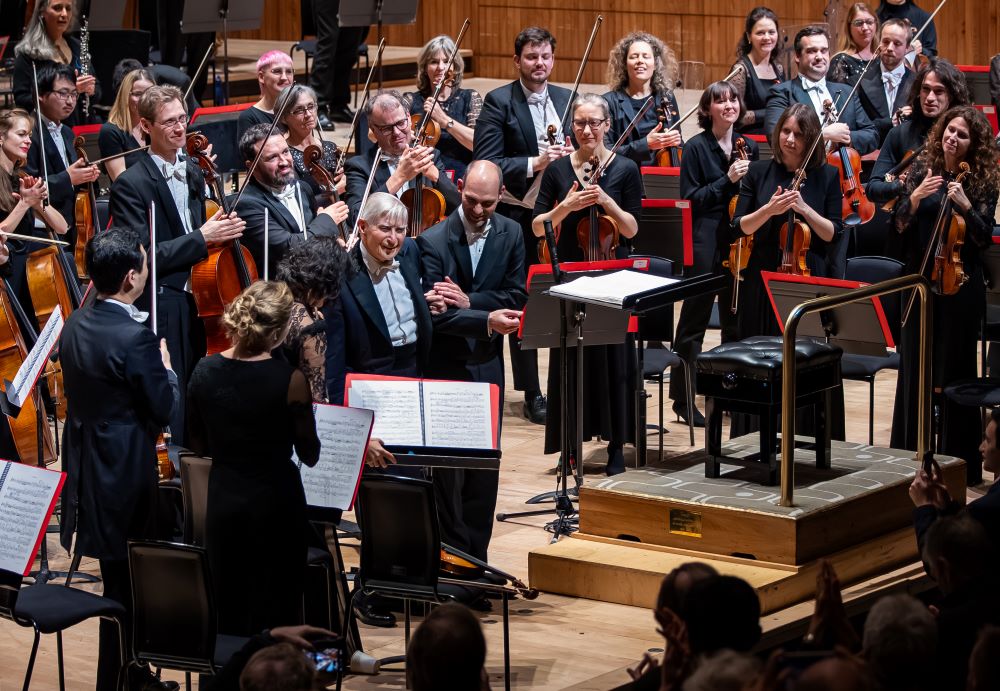 Woodwind were perfection throughout: hauntingly luminous, with very special tone from flautist Samuel Coles, and incisive in the earthy pipings and sarcastic shrieks of the inner movements. Stilling the precise vulgarities of the Rondo-Burleske, Jason Evans brought other-worldliness to the trumpet premonition of the great release, Blomstedt's subtle tempo-control making hardly any slackening for the reverie, and to a ghostly echo of it before the wild rumpus continued. One of the rare moments of left-hand-raising came to cue Christopher Gough's achingly beautiful horn solo in the Adagio.
Still, the clearest guidance came unmistakably from Blomstedt's batonless hands. Their language changed for each movement, from shaping long lines elegantly in the opening Andante comodo to precise flecks in country Ländlers and civic juggernaut, then on to wider gestures for the death-hymn of the finale - not in fact Mahler's last farewell, just as we hope this will not be Blomstedt's last appearance here. The deep sound of the strings kept hysteria and self-pity at bay;. the final cries and whispers rely on absolute stillness from the audience - five stars to the full house on the South Bank for not breaking the dream fade to nothing. You could hear the silences between the notes,as well as the long one when the music finally came to an end. It was up to Blomstedt, having taken the most gracious leave imaginable, to end it.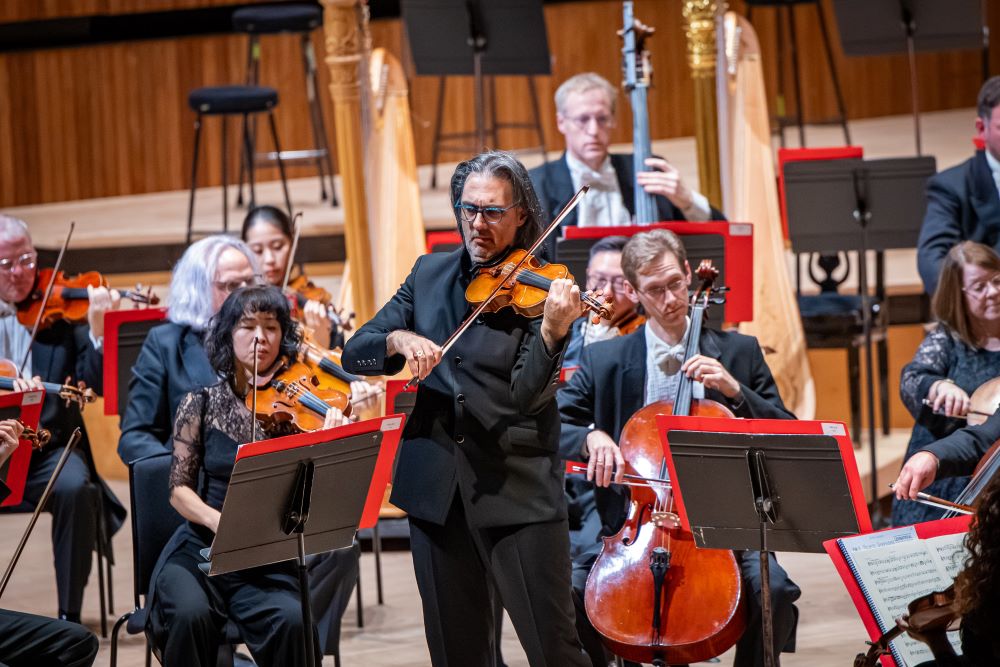 As elegant bonus we had Leonidas Kavakos in the first half directing a small body of players from the violin (pictured above) in Mozart's Fourth Violin Concerto. It's a pretty but generic piece, with less character than at least two of the other four until the Rondo Finale with its sprightly changes of metre. Kavakos goes a little inward while he's playing, but everything was in its proper place: along with the equally undemanding encore, the fourth movement (Menuets 1 and 2) of Bach’s Third Partita, a perfect appetiser for Mahler's colossal drama after the interval. That's unquestionably one for the ages alongside Abbado's in Lucerne - still the greatest experience of my concert going life - and Jurowski's with the London Philharmonic Orchestra.











