

Branding, as any marketing manager will tell you, is everything when it comes to selling, and when it comes to selling, classical music is no different from cars, cornflakes or shampoo. It explains why a Mahler orchestral song-cycle would fill the Royal Albert Hall while a similar work by his love-rival and near-contemporary Alexander von Zemlinsky last night left it half empty.
Zemlinsky’s Lyric Symphony is a seven-movement orchestral song-cycle with echoes (as Matthew Rye’s programme note reminded us) not only of Mahler’s Das Lied von der Erde, but also Schoenberg’s Gurrelieder. A dialogue between a soprano and baritone, the work’s passionate narrative plays out in their alternate songs, ending in loss and resignation. Matching Rabindranath Tagore’s English texts for heady lyricism, Zemlinsky’s score swathes its singers in layer after layer of gauzy harmony – at times bluesy, at others anticipating Korngold’s Hollywood.
Maltman’s lean baritone cut cleanly through the richness of Zemlinsky’s wilder fantasies
The BBC Symphony Orchestra gave conductor Simone Young (making a long overdue Proms debut) plenty of brass heft and string surge, but without ever finding the brilliance or textural clarity that would have brought the work into full focus. Efficient, rather than heartfelt, they provided the musical waves for soloists Christopher Maltman and Siobhan Stagg to ride. Maltman’s lean baritone cut cleanly through the richness of Zemlinsky’s wilder fantasies (“No more of this wine of kisses./ This mist of heavy incense stifles my heart”), shaping the phrases with lieder-like care.
While Stagg’s is not an enormous voice, there’s a blade to its purity that helped it project in this challenging space, carrying text and emotion to the back of the hall. The emotional arc of her delivery – from the innocent intensity of “Mutter, der junge Prinz” to the chilly withdrawal of “Vollende denn das letzte Lied” – was the thread on which the songs were threaded, a guiding constant through this extraordinary, excessive work.
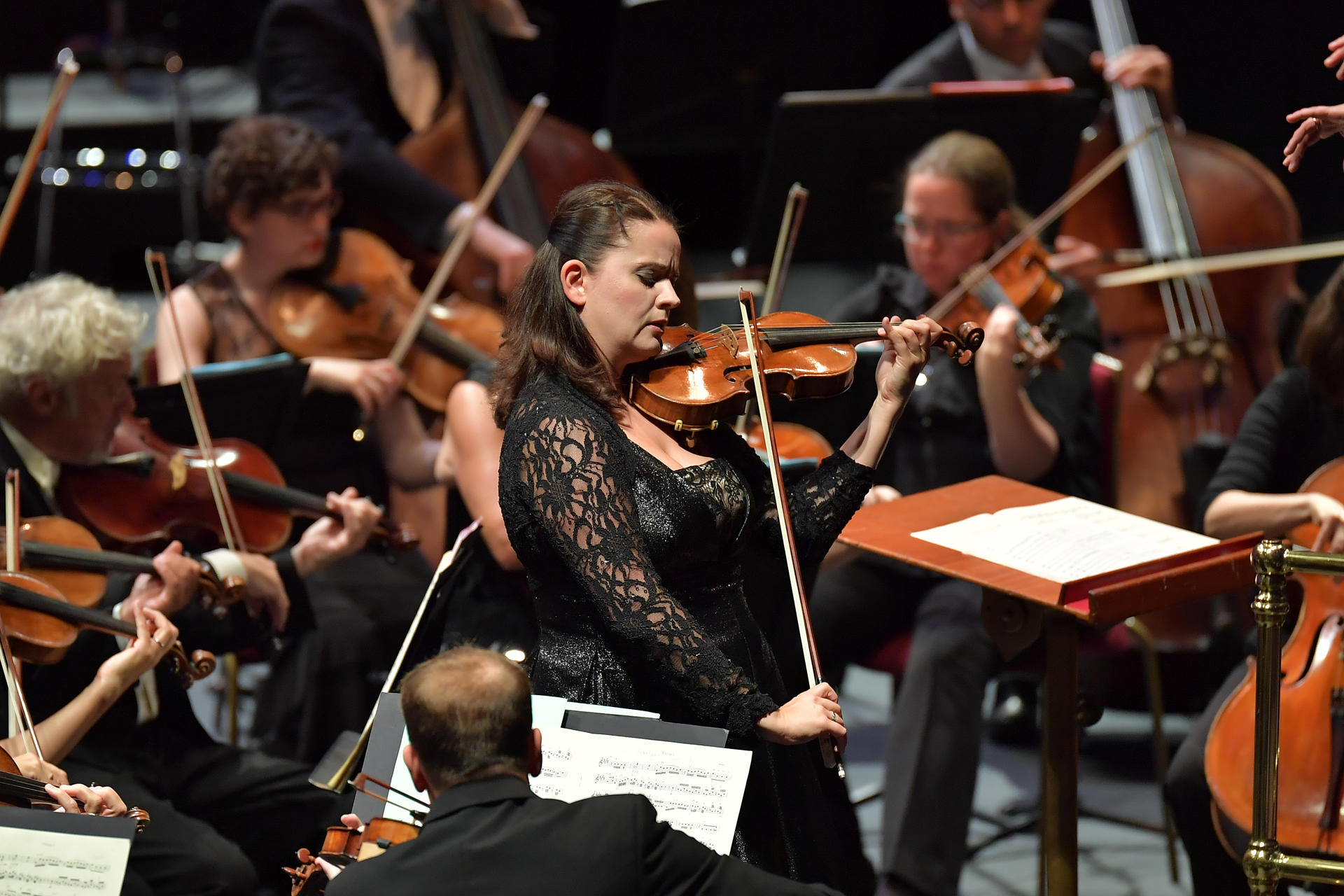 A hotch-potch piece of programming paired the Zemlinsky with Mozart’s Fifth Violin Concerto and a world premiere by composer and critic Bayan Northcott. The Mozart, with Latvian violinist Baibe Skride (pictured right) as soloist, was a curiously polite affair. Skride’s is a gorgeous, singing tone, one that begs for some Brahms or Grieg to show it off. Faced with Mozart (and cheeky Mozart at that) she refused to see the funny side, earnestly urging us to eschew the hijinks of the closing Rondeau, and snubbing the horn’s attempts at whimsical duets. Hers was a precise, elegant performance, at its best in the long melody of the central Adagio with its proto-Romantic loveliness. Despite Young’s best efforts a rather generously-sized BBCSO did little to help things take flight, offering some rather safe musical opinions in support.
Northcott’s Concerto for Orchestra – the composer’s first orchestral work – made for a confronting opener. Unashamedly dense, all but impossible to assimilate at a first hearing, this is absolute music at its purest, a skilful piece of music-about-music that makes no concession to emotional or programmatic narrative. Of the three continuous movements, it was the closing Allegro Molto, a slinky, syncopated dance of a rondo, that made the strongest mark, letting just the slightest musical twinkle enter the eye of this otherwise fairly stern piece.











