

Carmina Burana isn’t a masterpiece: it’s primarily a bit of fun; fun to listen to, fun to play, really fun to sing.
Few and far between are the performances where it ever manages to be much more than that, though this RSNO concert came close, mainly thanks to the conducting of Marzena Diakun, making her debut with the orchestra. The faster, louder sections were kept on an admirably tight leash so that the opening two "Fortuna" choruses really crackled, and the rumbustious choruses in the tavern were a hoot, the percussion giving it what can only be described as “welly.”
The bite and precision of the chorus was great in all of the above, with a bit of extra kick in the faster love choruses, climaxing in a grandiose roar through the "Blanziflor et Helena" section, and the cumulative effect was helped by having three top notch soloists. Adrian Dwyer squawked his way effectively through the music of the roasted swan, and soprano Fflur Wyn moved from tentative beginnings to a gorgeously persuasive "Dulcissime". Best of all was baritone Ben McAteer (pictured below on the right with Wyn, Diakun and members of the RSNO), who sounded lyrically persuasive in the Spring music, forthright in the love scenes, and semi-deranged in the tavern numbers.
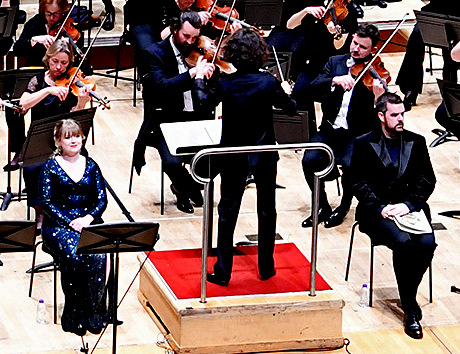 Unfortunately, the slower music sounded as though it was conducted by a different person, the tempo wound down so much that things dragged terribly. "Veris leta facies" seemed to take forever, as did the round dance at the end of "Uf dem Anger", which wasn’t saved by some gorgeously soft playing from the RSNO strings. Too often things were so slow as to be turgid, and the music’s flow was broken and inconsistent: there are a heck of a lot of repetitions in this music, and they all need to count for something.
I’m not sure there was much flow at all in the concert’s companion piece. Receiving its Scottish premiere, Elena Langer’s The Dong with a Luminous Nose is part cantata, part choral opera and part cello concerto. While it’s based on the nonsense poem by Edward Lear, Langer’s music takes the brave step of focusing on the sadness of the lovesick Dong rather than the silliness of the verse, exemplified by the keening sadness of the solo cello’s main cadenzas, all of which were invested with depth and feeling by the RSNO’s principal cello, Pei-Jee Ng.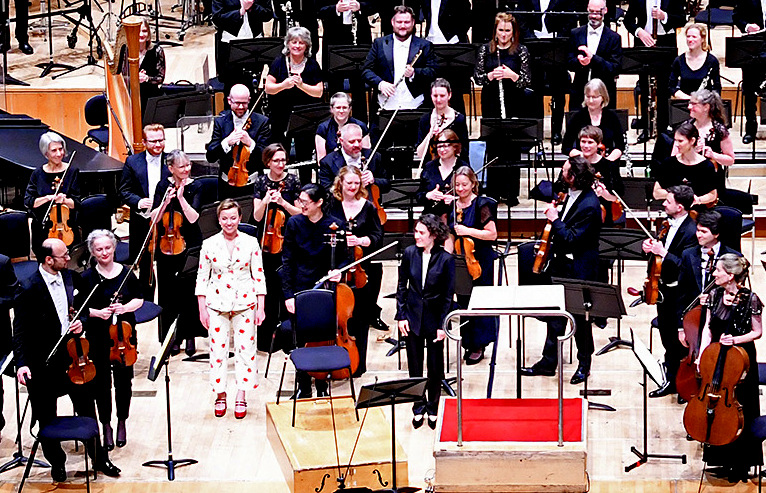 Langer (pictured below on the left with Diakun and members of the RSNO) writes an absurd waltz for the Dong’s love interest, and the orchestral soundscape glitters attractively throughout. She never solves the issues of balance, though, so that the cello frequently disappeared into the orchestral texture. The kids of the RSNO Youth Chorus put their adult counterparts to shame with the clarity and energy of their singing of Lear’s words, but overall Langer’s music sounded bitty and broken up, melodies flickering and vanishing without much central, unifying force. Maybe nonsense verse needs a different idiom to be translated convincingly into music.











