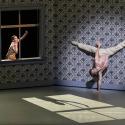
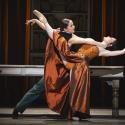
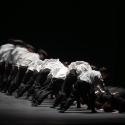
Serenade seems to be one of George Balanchine’s most evanescent works, a floating, delicate skein of movement that is over almost before it begins, leaving nothing but memory behind. In reality, it is tough as old boots, a warrior of a ballet, one that endures, survives – and enchants over and over.
It is, perhaps, a dandelion – one puff, and the wind disperses the seeds on the breeze, and yet like all weeds, it renews itself, finding new roots, as Serenade itself does new audiences. And Birmingham Royal Ballet’s return in this piece is always welcome. BRB has made Balanchine a focus of their repertoire, and they are more confident in performing his speedy yet off-centred moves than many.
A particular joy in this performance was Momoko Hirata, an explosion of energy and yet, simultaneously, a centred, serene presence (her dazzling pirouettes were a bonus). Céline Gittens was a lovely contrast, whose off-balance extensions showed an opposite, and yet equally beautiful, extreme. And the corps of 17 girls was immaculate as they did that most un-English thing, abandoning caution for speed.
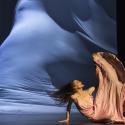
 A greater contrast than David Bintley’s early work for BRB, Carmina Burana, is hard to imagine (pictured above by Roy Smiljanic). Receiving its first revival in half a decade, the same dancers who had just shown us such fleet calm, now let their hair down to Carl Orff’s mid-20th-century wall of sound, sung with passion and commitment by Ex Cathedra (an especial commendation to their baritone, the resonant William Dazeley). Orff’s re-orchestrated medieval drinking songs, in Bintley’s hands, become the story of three seminarians losing their moral compass in a handful of the Seven Deadly Sins: lust, gluttony, greed, wrath and envy. (It is perhaps sensible that a choreographer leaves sloth untouched.)
Philip Prowse’s design takes equal billing with Bintley’s choreography – sometimes even overwhelming it, from bloodied hanging crucifixes, to dishes sprouting a dancing roast swan (a provocative Jenna Roberts) and a rowdy nightclub. Mathias Dingman gave a fizzling performance as the lustful, raging seminarian left bloodied on the ground. Iain Mackay was equally good as he lost his soul to a red-dressed siren (Samara Downs) who, it turns out, is Fortuna herself, as the wheel turns, and we end up where we began, with the scales being weighed and humanity found wanting by Fortuna Imperatrix Mundi – Fortune, Empress of the World.