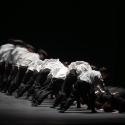
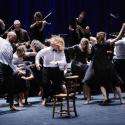
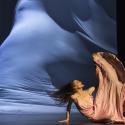
There’s sun and sand, and both are golden – but this is no holiday beach. Distantly, out of focus, you can make out a man with a donkey and cart. Off-camera, some locals kick a ball. A square of sand about the size of a tennis court has been carefully raked in preparation for a performance – a unique performance, as it turns out.
Early this year, 38 dancers from 14 African countries were assembled to mount a production of The Rite of Spring in the 1975 landmark version by the late Pina Bausch. It was due to premiere in Dakar in mid-March followed by an international tour. But then lockdown struck, public gatherings were banned and borders closed. Distraught, but determined to seize the moment, the company decamped to the beach near their base at Toubab Dialaw, Senegal, for a final run-through, knowing that this would be their last time together as a group for – well, nobody knew how long. The filmmaker Florian Heinzen-Ziob and his small crew, who had been documenting the project, sprang into action to capture the impromptu rehearsal just as the sun had set over the sea and the sky bleached to white.
The galvanising element of the resulting film is the musical performance – an unsurpassed recording made by the Cleveland Symphony Orchestra in 1969 under the baton of Pierre Boulez. The playing is so vibrant, so articulate, that instrumental lines which in other renderings are simply inaudible come dazzlingly into focus. The accumulated sound is at times almost terrifying.
But back to the dance and the fate of this project. Who can say whether the adrenalin that powers this extraordinary filmed performance derived partly from the dancers’ experience that day in March – their fears about what lay in store for them and for the world at large? In her response to Stravinsky’s elemental score, Pina Bausch had posed the disquieting question: “How would you dance if you knew you were about to die?” And whatever the exact narrative of this Rite – the most widely admired of the many settings of the music – it’s clear even to the least discerning eye that it's about the behaviour of early human society. Superstition is rife, but so is brutality and base terror.
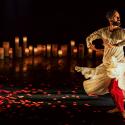
As a stiff Atlantic breeze ruffles the silk shifts of the women and billows the trousers of the bare-chested men, a desperate tension is palpable. Perhaps the most fascinating element of the work is the way the choreography counterpoints individuals and the mass, or rather masses, male and female. The choreographer herds them as if they were goats or wildebeest, and they respond in kind, acting largely in the interests of group preservation.
Exactly what the pan-African casting brings to the piece is hard to say beyond what you see. This is work in progress after all, filmed a full 10 days before the dancers expected to perform before an audience. Yet there is a strength, beauty and ferocity in the execution that must owe something to the performers’ mixed dance backgrounds – many of them trained in African dance rather than Western contemporary. What's more, the film’s up-close camera work allows the visceral detail to register more powerfully than would ever be possible in a theatre. Whether running, falling or huddling, whether airborne in statuesque poses or simulating violent copulation, these fabulous dancers give their all.
As one of the producers from the Pina Bausch company commented bluntly: “If you’re not exhausted at the end, you haven’t danced it properly.”