A voice at the start of dancer Aakash Odedra’s performance speaks out of the darkness about the Sufi myth behind what we are going to see, one of a caged bulbul — a nightingale — yearning to be merged with the divine and singing for its freedom in ever more beautiful ways. In this, the voice says, the bulbul represents the artist’s quest for perfection, always refining his work until death brings a sense of freedom and transcendence.
What follows is a simple yet extraordinary, lavish piece choreographed by Rani Khanam and performed to the music of Rushil Ranjan, played by the Manchester Camerata. This introduction promises a portrait of suffering, but it’s projected in dancing of the highest order.
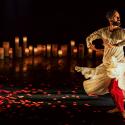
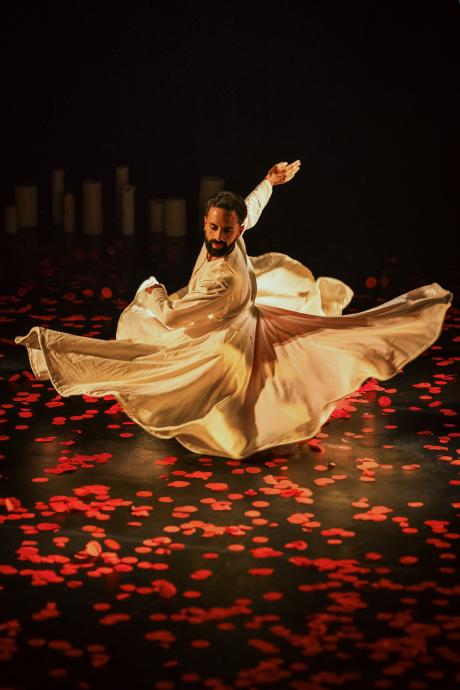
When the stage lights go up, light glimmers in one high corner of the space; down below is a grey mass on a floor strewn with red rose petals, with a semicircle of big candles on its perimeter. The mass moves and the dancer inside the grey cloth sac starts to emerge, like a calf being born, until he can use both his arms as pliant wings and skitters around the stage, first on his knees, then sideways, back and forth, on his feet, as if learning to walk for the first time.
The score meanwhile has blossomed into a rich mix of strings, flutes, sitar and tabla, with Sarthak Kalyani’s and Abi Sampa’s’s full-throated, melodious voices soaring over the orchestration. No translation is offered of the lyrics, but the music is brimming with different emotions, sometimes exultant then dying down to a quiet poignancy.
Odedra leaps like a young deer or stamps his feet to the tabla beat, his head at times moving like a bird’s and flicking his fingers and feet to the music. He always seems to be in motion. He is dressed in a long white tunic with full skirts over white trousers, a costume that seems to take on a life of its own. Sometimes his skirts are held up like wings, sometimes he twirls so fast that they rise up and encircle his body, a blurred wheel of white. It’s a beautiful effect, reminiscent of an ice skater’s spins.
As the man/bulbul’s captivity becomes more oppressive and his sight is destroyed, the lights all but disappear and ethereal two-voiced vocals are heard, backed by ominous strings. He tries to get past the poles that have descended with a clack on one side, but, to plaintive music, he can’t get through them, his body’s struggles cleverly accentuated by a strobe lighting effect. Hands (his own) reach round his face and he cries out in anguish, next appearing with bandaged eyes.
For the climactic scene, the lighting is bright, and the music becomes mellow and heartfelf, like the swelling of a film score, while the dancer twirls slowly, dignified and elegant. He commands lights to appear, like a master magician, and performs a lovely routine with small handheld lights, moving them from hand to hand to the ping of a xylophone. One little light is left to rise alone all the way up into the flies.
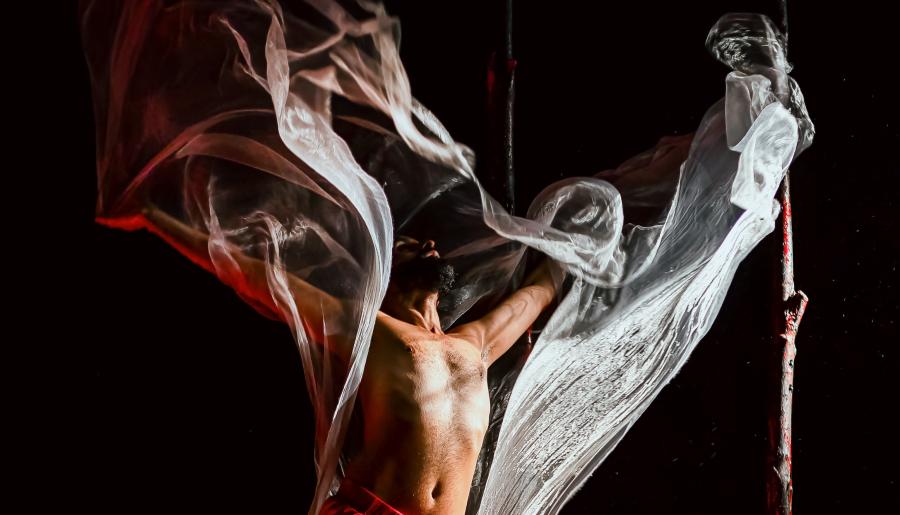
Then all goes black again. The final tableau returns us to the first one, with a dark mass on the stage under a grey cloth and the dancer’s body moving beneath it. The effect the piece achieves next is extraordinary, the cloth becoming a silvery, transparent membrane that rises up while the dancer sinks down, smoke emanating from his body.
Odedra Is like a man possessed for the full hour of this piece, a serene presence even when he is embodying pain and despair. The vocabulary of steps available to him is relatively limited, but within its lexicon of spins and skips and foot-stamps he finds a rich characterisation, performed with immense energy and skill. The music is a character in itself, full of longing and poignancy, yet the overall effect is, as the voice had promised at the start, illuminating and uplifting.
- Songs of the Bulbul at Sadler’s Wells East until 11 July, then Cambridge Arts Theatre 21 July
- More dance reviews on theartsdesk