After the disappointment of Wayne McGregor’s latest piece for the Royal Ballet, which opened on Monday, I thought last night’s trip to Sadler’s Wells for a new Rambert programme might cheer me up about the state of contemporary dance and composition. Two new pieces were on offer, by rising choreographer Alexander Whitley and Rambert director Mark Baldwin with original scores by Icelander Daniel Bjarnason and Brit Gavin Higgins respectively, alongside a revival of Lucinda Childs’s Four Elements, and there was no sign of the fawning hype that preceded the McGregor opening. Were we in for diamonds in the rough in Islington?
In a word, no. Whitley, whose Frames opened the evening, is a pretty successful young choreographer, having had major commissions from Birmingham Royal Ballet, Sadler’s Wells and BalletBoyz in the past 12 months, as well as touring his own company. There’s no doubt he can come up with exciting movement, but there’s also no doubt he needs refining before he really makes the big time. In every piece of his I’ve seen so far, the running time has seriously outdistanced the choreographic material’s intrinsic interest, and my enjoyment has depended significantly on the quality of the dancers and the score – the choreography itself seeming to have no power to transcend or redeem bad music and bad performance.
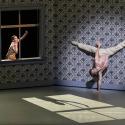
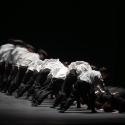
Frames, unfortunately, suffered in both these respects. Rambert have some good dancers, and the material shouldn’t have been beyond them, but they were unforgivably hampered by wearing shirts and jeans which didn’t allow them to move properly – all Whitley’s low lunges and sharply bent knees, as well as jumps which ought to have hung in the air as cleanly as a Nike tick, were blunted by the constrictions of the costumes. The dancers also looked dreadfully distracted by the need to faff around with aluminium bars (designed, like the clothes, by Revital Cohen and Tuur van Balen) to build the frames of the title: the few striking visuals generated by the off-kilter rectangles once constructed were no compensation for the awkwardness of their constant presence or the even worse fumbling needed to attach them to wires and fly them off. As for the music, Daniel Bjarnason’s soundscape of muffled heartbeats, scraped piano wires and static had no shape and drama at all. I have no idea how many minutes Frames lasted, but it was at least four times as long as it should have been.
 The closing piece, Baldwin’s Dark Arteries, was far better served in its music. Gavin Higgins is a properly orchestral composer, capable of handling multiple textures and harmonic and rhythmic complexity in a way sadly too rare in contemporary dance scores. A brass band cornet player himself, for Dark Arteries he has revisited his roots by composing for the Tredegar Town Band, who share the stage with – and, frankly, steal it from – Rambert’s dancers. I was fascinated by the sonority of the brass players, surprisingly velvety en masse and yet so airy in solos.
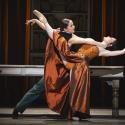
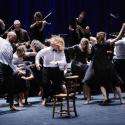
Higgins’s music is slow and subtle, and I would really have liked to listen with my eyes shut; as with Higgins and Baldwin's 2010 collaboration, the dance, in this case loosely inspired by the 1984-85 miners’ strike felt like a distraction. The piece falls into three sections, which I interpreted as representing the stable mining community, the community as threatened and fractured by the strike, and the community now, emptied of its vital blood in the coal, but still finding ways to love and to hope – even new ways, a homoerotic duet implies. In the first section, any sense of a striking movement language was obscured by dark blue and purple costumes under dark lighting. Some energy and bite appeared in the second section, with people running and shaking their fists. But a feeling of confidence and verve only really appeared in the third movement with its clean, stylish duets (pictured above right), chief among them that between two young men, and by then it was really too little, too late, as well as too long.
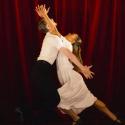
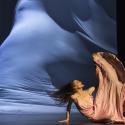
 I was cool on American choreographer Lucinda Childs’s minimalist Four Elements (1990) last time round, but I'm revising my opinion upwards: it’s a refreshing slice of cucumber when placed between the starchy slabs of Frames and Dark Arteries. The liquid woodwind burblings of Gavin Bryars’s score, like the silky leaps and turns in the choreography (pictured left), are repetitive but subtly shaped, an infinitely slow build that never loses a sense of where it’s going. Not all the dancers seemed to know where they were going, however – signs of under-rehearsal? – and those without a serious ballet background couldn’t rise to Childs’s unforgiving neoclassical neatness. The less said about the garish painted backdrops the better – although were you to get bored, wondering whether the creatures trying to get into the red box are small-headed badgers or fat muntjac deer might prove a useful distraction.
All credit to Rambert for commissioning new works, but when a poorly-designed, decades-old, middling quality piece from a good choreographer’s back catalogue is the highlight of a bill, and when amateur musicians outshine the dancers, it's hard to go away feeling any more cheerful about the state of contemporary dance than I did at the start.
- Dark Arteries is at Sadler's Wells until 16 May.