No one ever accused of Anne Teresa De Keersmaeker of thinking small. Or not thinking, for that matter. Her international career began with a bang, when with only her second work she created Fase, Four Movements to the Music of Steve Reich. And Reich’s music, filled with repetitive figures, harmonic rhythm and canons, is not a million miles – even if it’s 600 years – away from the ars subtilior of Avignon, De Keersmaeker’s new musical focus.
A type of 14th-century polyphony, the songs of this mannerist style are highly complex technically: difficult to perform, they are more like 20th-century avant-garde music than anything that falls between now and then. Their attraction to De Keersmaeker, in other words, must have been instantaneous. She too has always focused on highly complex pieces, on patterns, on shapes, on mathematical workings-out of a musical style.
 En Atendant was originally staged in Avignon, on the medieval walls at dusk. Here the stripped back flats of Sadler’s Wells have to stand in, and some atmosphere is obviously lost. Yet when flautist Michael Schmid appears, to create a range of sounds that no modern flute was ever designed to make, the archaism of the sound world is established immediately. As always with De Keersmaeker, it goes on for longer than seems entirely sane, and yet, also as always, you come out the other side feeling altered, stripped back.
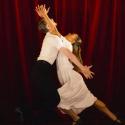
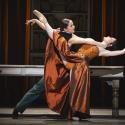
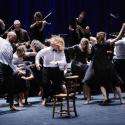
Then eight dancers appear, five men and three women. Based entirely on a walking step, they pace out what swiftly becomes clear is the score: one note, one step. This is intermittently entwined by three musical performers, the wonderfully lush soprano of Annelies Van Gramberen, Thomas Baeté on viol and Bart Coen on recorder.
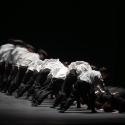
Gradually it is possible to distinguish the different musical “voices” among the dancers – two men perform a stamping quick-step, while a third marks time more slowly, as though he’s the continuo.
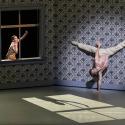
 De Keersmaeker is not content to leave it there, however, and a further theoretical layer is added as she divides each dancer in two – the lower body dancing, the upper body shaping out a series of mathematical points on a grid, a sort of proto-Renaissance exploration of the golden ratio.
I’m not really sure that this layer adds anything, and in some ways it is a distraction. When the music is absent, the works can fail to cohere, producing work that is intelligent, and interesting, but not felt.
The second part of De Keersmaeker’s engagement with ars subtilior is her Cesena, which will be performed later in the week; it is only then, I suspect, that the overall pattern will emerge.
Watch En Atendant from the Festival d'Avignon