Mention Isadora Duncan and the best response you’re likely to get is “Wasn’t she that dancer who died when her scarf got caught in the wheels of a Bugatti?” The closing scene of the 1968 biopic starring Vanessa Redgrave seems to have blotted out everything Duncan actually achieved.
This triple bill by the Viviana Durante Company attempts a correction by paying homage to this early 20th-century celebrity totem of female emancipation as the true founder of modern dance. Not only did her free-flowing, barefoot style pave the way for the artistically weightier innovations of the Ballets Russes and later Martha Graham, but it infiltrated the popular consciousness to an extraordinary degree. Traditionalists feared for the morals of those exposed to Duncan’s performances. Fashionable mothers clamoured to enrol their daughters to her schools. Tens of thousands around the world fell under her spell, the teenage Frederick Ashton among them, claiming a damascene conversion after watching her dance. The difficulty for us now, faced with a reconstruction of her work, is that it takes a strenuous leap of the imagination to see why.
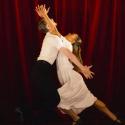
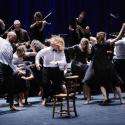
 The best that can be said of The Dance of the Furies (pictured above), first performed in Paris in 1911 and set to music from Gluck’s opera Orfeo ed Euridice, is that it has historical interest. Circling a fire pit on an otherwise black stage, five women stride and scamper, intermittently striking power poses with splayed thighs and bunched fists. Exposed legs and streaming hair may now be unremarkable on stage, but a century ago they broke every rule of feminine decorousness. First-wave feminism was already threatening the status quo. In London that year suffragettes were engaging on hunger strikes and Emmeline Pankhurst was throwing rocks at Number 10. The fact that Duncan’s dancers were enacting characters in an Ancient Greek myth didn’t lessen the affront of their deliberately ugly, bulky movements, not to mention the contorting of their faces in demonic, silent screams.
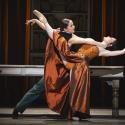
It’s a shame that today these antics look crude and even laughable, but it's surely an indictment of Duncan’s art that it hasn’t aged better. It might have helped director Viviana Durante’s crusading cause if she’d balanced the Furies with a second, more lyrical reconstruction. Instead she chose Five Brahms Waltzes in the Manner of Isadora Duncan, Frederick Ashton’s 1976 homage to the luminous performer he remembered from more than half a century before. Perhaps Durante was swayed by the desire to perform this beautifully constructed solo herself. Too bad injury forced her to back down. Instead it fell to Begona Cao to hold the stage for 20 minutes alongside a grand piano and pianist Anna Geniushene. Without scenery or props beyond a fistful of rose petals and a silk shawl, she breasted imaginary breezes, darted after invisible butterflies and made a general obeisance to nature with a sincerity and sensuousness to win over the most cynical 21st-century heart.
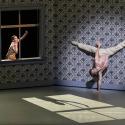
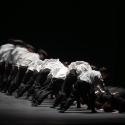
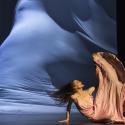
 The programme was completed by a new work, Unda, by Joy Alpuerto Ritter (pictured above). Employing an all-female chorus similar to Duncan’s, she constructs a series of semi-abstract vignettes on themes touching Duncan’s life and preoccupations – the natural world and in particular the sea – in a movement style that’s more evolved than Duncan’s, but bears its traces. Likewise, Grecian urns and pillars are the only design features, and it is at points faintly thrilling to see strong, lithe bodies take full advantage of a very large stage, sometimes simply by running. The original music is generated live on stage by cellist-composer Lih Qun Wong, operating a loop with her foot as she riffs on the cello.
While there is evident skill in deploying six dancers non stop for 40 minutes, and imagination in the neat motif of waves (and even a suggestion of the accidental death by drowning of Duncan’s two children), Unda is over-ambitious. It seemed particularly rash to make a feature of water trickling from the ceiling in the week Cloudgate was going to be in town, the Taiwanese dance-theatre company being famous for its spectacular use of the elements. This wasn't nearly spectacular enough.