Federico Fellini’s 1954 classic La Strada ought to be a gift to a choreographer. The film has pathos, good and evil, a bewitchingly gamine heroine, and incidental music by the great Nino Rota, a composer who can find melancholy in the music of carnival and joy in a tragic trumpet solo – a composer who makes you think “Italy” in every phrase. Yet, in the dance adaptation that has just premiered at Sadler’s Wells, that strangest of road movies seems increasingly untranslatable.
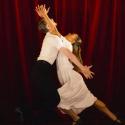
Not that the show doesn’t contain many pleasingly fluid sequences of dance, which sometimes soar. Choreographer Natalia Horečná knows her craft and exploits the extraordinary capabilities of her star, Alina Cojocaru (who commissioned this project), with flair (Main picture: Alina Cojocaru with Mick Zeni). But her loose filleting of Fellini’s narrative, far from finding the film’s beating heart, ends up making something quite alien, full of unforeseen stops and detours, and multiple bumps in the road. One of its problems, oddly enough, is the music. Although Nino Rota himself assembled some of his film scores to make a short ballet suite he called La Strada, this isn’t it. Most of the music in Horečná’s dance adaptation comes from other films, including the ballroom scenes in The Leopard, which of course is by Visconti, not Fellini, and a film about Italy’s glossy aristocracy, not its desperate, post World War Two poor. The plot of Fellini’s La Strada is a harsh, dark fairytale, like something the Brothers Grimm might have written. Gelsomina, a young girl, still a child, is sold by her widowed mother to an itinerant circus strongman, Zampano – a depressive, violent loner whose purpose in taking on Gelsomina is never entirely clear. Is she to fill the role of cook, concubine, or strongman’s assistant? Most likely, given Zampano’s vagrancy, criss-crossing the dusty wastes of southern Italy on a beaten-up motorbike-cum-waggon, he simply wants her to keep him warm at night.
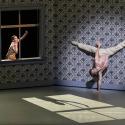
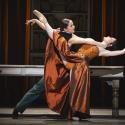
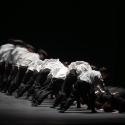
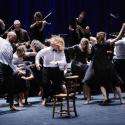
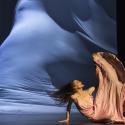
The ballet offers no clue to the harsh landscapes of the film, so important to its sense of poverty and desolation. It struggles even to depict Zampano’s solitariness, magnifying the very brief section of the film in which he and Gelsomina attach themselves to a troupe of circus artistes to the extent that it takes up most of the show. These hyperactive performers (pictured above) help fill the stage and busy the eye, but fatally weaken the story. The single important character among them is Il Matto (Johan Kobborg), a tightrope walker who we only ever see on a unicycle. His kindness to Gelsomina (pictured below) provokes the strongman (Mick Zeni) into a jealous rage, but before Il Matto comes to a sticky end, there is some exciting choreography for the three of them. The superlative quality of these three dance-actors is almost enough to save the show.
 Aware perhaps of a paucity of plot, the choreographer adds an element of mysticism in the form of a pair of angels who appear only to Gelsomina and help her in her darkest hours. This will puzzle those who know Fellini’s film as much as those who don’t. These asexual beings (Marc Jubete and David Rodriguez) perform the useful dance function of enabling Cojocaru to soar and float, skilfully held aloft by them, bestowing her goodness on a wicked world. Her floating is a lovely effect, if overused throughout the ballet. And although there are no angels in Fellini’s film, angels do have form in Italian neo-realist cinema, not least in Vittorio De Sica’s fantasy film Miracle in Milan, which appeared only two years before La Strada.
While I very much wanted to like this show, it has too many longueurs and lacunae. And for all its cavorting circus people (including a distracting babe in a glittery bikini who seems to have strayed off the set of La Dolce Vita), it fails to capture that special wistful quality that pervades many of Fellini’s films, as well as the films of his contemporaries. In a devastated 1950s Italy, it’s a wistfulness for a past of love and laughter, a memory of carnivals long gone by, and for two centuries before that, the commedia. It’s what makes Italian cinema what it is, and this ballet doesn’t get anywhere close.