Sure, there are things not to like about Kenneth MacMillan's Mayerling. Confusing plot. Plethora of characters. Unsympathetic (anti-)hero. Borderline melodramatic choreography. Tense, scary dénouement. But to be at the Royal Opera House last night was to be convinced that Mayerling's merits far outweigh its demerits. A piece which can provoke the whole Royal Ballet company, dancers and musicians alike, to make such focused, sincere theatrical magic as we witnessed last night is a repertoire jewel, and seeing it done by its home company is an experience every ballet fan should have at least once.
 Crown Prince Rudolf, the mentally unstable Austrian heir whose deteriorating behaviour and eventual, scandalous, suicide with his teenage mistress are the ballet's focus, is ballet's Hamlet, the star role only a few dazzling dance-actors will be granted, or deserve. Edward Watson has replaced Carlos Acosta as the Royal Ballet's Rudolf par excellence, and what a tour de force he presents us with. Watson leans into MacMillan's twisting steps for Rudolf with the full force of his trademark suppleness: Rudolf's body, like his mind, is travelling in tortured circles, out of which he tries - but fails - to break (any step which looks like it might lead to a more open position of body or head ends up turning in, closing down, or doubling back on itself). Watson rises to the physical demands of the role with astonishing power, capturing fully the hypnotic quality of the mad prince's dangerous downward spiral.
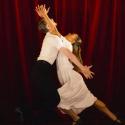
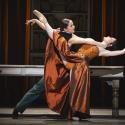
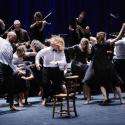
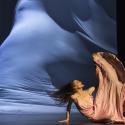
So fascinating is he that one understands why so many women circle Rudolf: he must duet with his mother, his wife, and some three or four former, current, or potential mistresses. In an embarrassment of casting riches, last night all were played by Royal Ballet principals (counting the character artists there were in total 10 principals on stage). The headline female role is Mary Vetsera, the young girl whose madness almost matches Rudolf's and who goes to her death with/because of him. Natalia Osipova's almost nonchalant virtuosity makes her an excellent partner for Watson in this ballet, and in the final two scenes of increasing threat, the two of them (pictured above right) were utterly compelling. So wrapped up in each other that even Alexander Campbell's crisp, ebullient clowning could not break the fug of their obsession, they twined round each other like crazed cats, high (or low) on drugs and despair. But Vetsera has a lot of competition in Rudolf's life, and Osipova had competition too: earlier, the stage had been dominated in turn by all the other ballerinas in a cast with not a single weak link. Francesca Hayward played poor Princess Stephanie, Rudolf's young and unloved wife, with a really nice hint of grit and backbone. With its threatening bedroom pas de deux, the part is an audition piece for playing Vetsera, a role Hayward is known to covet and in which, on this evidence, I would cast her in a heartbeat. Sarah Lamb (pictured left with Watson) makes commendably charismatic work of perhaps the trickiest role, Countess Larisch, who has more dance time with Rudolf than almost anyone else, but is a conflicted character, playing all sorts of risky games with him and others. Marianela Nuñez gets to play the courtesan Mitzi Caspar, probably the only woman in the ballet who ends up not too unhappy, a perfect role for Nuñez's sunny constitution and effervescently correct dancing. Empress Elisabeth, Rudolf's mother, was inhabited by the scene-stealingly wonderful Zenaida Yanowsky: in her pas de deux with Watson, the ballet's Hamlet-Gertrude scene, she goes through an almost unbearable range of (bad) emotional responses to her troubled son, from stiff formality to fervid affection to tortured tears. If we needed reminding to be sad about the imminent retirement from the company of this splendidly refined, intelligent dancer, here was ample reason.
It was one of those magical evenings at the theatre where the chemistry clicked for everyone, not just among the dancers, but between dancers and orchestra, and between all performers and the audience. Martin Yates's conducting was empathetic, sensitive and heartfelt throughout, fully articulating the psychological insights of Liszt as captured by John Lanchbery's skilfully orchestrated composite score. The orchestra too seemed to be fired by inspiration: from the first moments of the overture, an uneasy dialogue of woodwind and strings, we were plunged into Mayerling's simmering world of tensions and divisions, all lucidly coloured by the various sections (with some lovely flute-playing in particular).
MacMillan's experiments in character-driven ballet did not convince everybody when he was alive; many ballet fans still do not see the point. There are some ballets of his that I too would rather not watch. But a performance of Mayerling like last night's proves beyond all doubt that MacMillan was a genius, and that his unique vision for what narrative ballet could do was not just pipe-dreaming, but - with the Royal Ballet dancers - a realisable vision. Mayerling may be difficult, but in the hands of the Royal Ballet and with Watson in the title role, it is absolutely essential.
- The Royal Ballet perform Mayerling at the Royal Opera House until 13 May.
- Read more dance reviews on theartsdesk