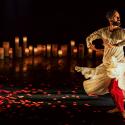
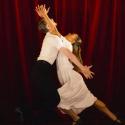
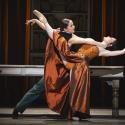
The publicity said it would be dark. But who would have guessed The Mother would be this dark? With its tally of dead and dying babies, gouged eye sockets and flayed skin, Arthur Pita’s latest dance-drama vehicle for the phenomenal Natalia Osipova, loosely based on a story by Hans Christian Andersen, gives HBO’s Chernobyl a run for its money.
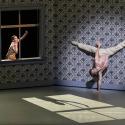
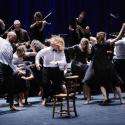
Even Yann Seabra’s set – a revolving suite of poorly furnished rooms, all dingy wallpaper and stained sanitary ware – seems to have come from the same job lot. Russian folk memory seeps from every blood-smeared pore of this grisly tale with its cast of grim reapers, witches, hags and homunculi (superbly multi-roled by co-star Jonathan Goddard, pictured below), each of them intent on taunting, maiming, haunting or otherwise snuffing out hope. Our first sight of Osipova’s Mother is slumped exhausted by her baby’s cot. The child is ill and the young woman frantic with worry, more still when she wakes to find the cot empty. The original story sends her on a wild outdoor quest to find and plead with the thief, who is of course Death. In Pita’s version, she paces her apartment in varying states of derangement, prey to a stream of malevolent visions. This is "Post-partum Psychosis: the Dance-drama", and pregnant ballet fans would do well to stay away.
The mood is set, and impressively maintained over 90 minutes, by musician-composers Frank Moon and Dave Price, each marooned on an island of musical kit to right and left of the stage. Their semi-improvised whines, howls, creaks and folk-melodising on fiddle, flute, balalaika and countless other analogue instruments both background and foreground the show with a multi-layered virtuosity.
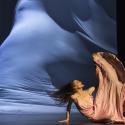
 Pita has worked with Osipova before, and it shows. He knows just how to exploit her strength and pliancy as a dancer, her fearlessness as a dance-actor, and The Mother pushes her to new extremes. This is a dancer who flicks her knee to her ear as easily as others might bat away a fly. Crucially, though, she imbues every gesture, every reach of an arm or stretch of a foot, with kinetic sense, as if it's part of a conversation, or the snap of an idea in her head. However wretched this character’s ordeals – sacrificing her eyes to a blind man is an especial horror – you cannot not watch. She is mesmerising.
As in the best re-tellings of traditional stories, such as those of Matthew Bourne, The Mother is layered with cross-cultural allusions – some of them reflecting back on ballet's own past. When a peasant woman, a babushka, offers to trade information on the baby's whereabouts, she demands that the Mother dance till she drops – a clear nod to the sadistic wilis in Giselle, which happens to be Osipova's signature role on the classical ballet stage.
There's more, though. As the Mother dutifully reels off the folk dances of her girlhood with increasing intensity (scraps of the handkerchief dance, traditionally danced by Russian brides, offers a rare moment of dreamy lyricism), the climactic central moment of Tolstoy's War and Peace is suddenly there before you. A light goes on. Ah yes, of course, Natasha's Dance.
Some scenes would benefit from pruning. Bound by poisonous garlands or taunted by the sound of infant crying on the radio, Osipova’s tortured flailing goes on far too long. But this is nonetheless a highly original piece whose resonances keep on giving in the manner of the best film noir. With its tiny cast and big impact, The Mother is a certain hit for international touring. We can only hope that it will return to London for a proper run before too long. This is the stuff of dreams that so many great works of dance are made on. It's just that these dreams are bad ones, about as bad as dreams can get.